Why do we keep talking about dieting and special diets?

Dieting, Diet, Food, Movement

What shall we eat? No more pixie dust, that’s for sure…

Recent posts by one of the very few sources I consider reliable on nutrition prompted me to revisit the theme of diet. So I hope you can stomach one more post on this topic. I’m going to try to make it worth your while by presenting a hint of a solution.

If you have not yet read what Dr. David Katz has to say on the subject, stop reading this right now, and go read a few of his posts instead. I won’t mind. Really.

Still with me? Perhaps you only have a few minutes, so allow me to summarize the current status. (And provide links to his most recent and relevant posts; some are on LinkedIn and may require an account to access.)

Let me make something clear right off the bat:

Dieting does No Good

Dieting does not work. It’s that simple. I’ve written about it myself, and this post by Dr. Katz is quite entertainingly showing that all serious nutrition experts, those not trying to sell you something, say so.

This video about a much-publicized recent study does what journalists always (erroneously) think is better journalism: providing statements from both sides, even though it is a non-debate.

Even having a good overall diet, eating food (not too much) and mostly from plants, is not enough if you are trying to lose a lot of weight, and/or remain healthy for a really long time. For that, you need to exercise, to move, on a daily basis. It is a lifestyle issue, not a diet issue.

But that’s hard work. Are we sure there’s nothing we can do about the food we eat? (Or so we keep asking ourselves.)

In the absence of successful “mainstream” diets, people turn to even stranger diets, like the would-be paleo diet. But even that, as I’ve indicated previously, and as Dr. Katz has put it time and time again (as reported here as well), is part of repeated attempts at making believe we can get fit and slim without doing real work.

So despite dieting not working, why do we keep talking about diet as if it is the solution? Why is it that every so often a new kind of special diet starts and claims to be the solution we’ve been looking for?

Basically, the question is:

Why do we keep focusing on dieting?

Because it is appealing to us.

Most (all?) of us have a tendency to seek easy fixes, magical solutions, silver bullets. I feel this is primarily due to our innate tendency to assign simple cause and effect relationships to phenomena: if this bush moves, that’s probably because there is a tiger ready to jump on me, sort of thinking. In this case: I’m getting fatter, so it must be what I’m eating.

To some extent it is, but that’s not the point. We focus on the wrong culprit at the expense of the white elephant on the couch.

The main aspect of our lifestyle that is different from what our ancestors of even a hundred years ago had to deal with is lack of movement.

Yes, it would be harder to move a lot more; it is effort. But there is more at play:

We are constantly bombarded by good stories that, even though they are scientifically unsound, appeal to our innate need for those causation narratives. Those stories are how modern snake oil salespersons get us time and time again.

If, as I surmise, this is a big part of the problem, it also suggests a way to fight.

A way forward?

While I generally agree with Dr. Katz that we should “grow up” about it, and that we must make the effort to eat well, along with exercising, not smoking, etc., I think we need a pro-active approach as well.

Since the ease with which stories can be created about special diets is part of the problem, perhaps a good story could be part of the solution. We need new narratives to replace those of the pixie dust diets, successful precisely because, although they don’t stand up to scientific scrutiny, they appeal to us through simple (simplistic) stories. We can keep telling ourselves, and others, the well-articulated lies we were told by the dieting peddlers precisely because they are simple enough.

On the other hand, the “I eat food, not too much, mostly from plants” story requires more explanations when you try to discuss it with others, and few of us have the knowledge to feel comfortable doing that.

There should not be a need for more explanation; our ancestors did not feel such need. They just ate what food they had.

The problem nowadays is that we have way too much, and it is all way too rich for our own good. In a see of contradictory advice and the occasional about-face of scientists themselves (which is even harder to explain for non-scientists), we all feel a need to justify our choices.

What better way to justify those choices than a good story?

So that’s the narrative, the story, we need to work on, instead of just de-bunking the others (not that there’s anything wrong with de-bunking). Allow me to have a go at a first draft.

A proto-story for healthy living

Begin Story

I am a human being, an animal that has evolved over millions of years to actively seek and eat a wide variety of plants and other animals.

Lately I’ve been extracting even more nutriments from my environment by cooking and domesticating my food sources. That’s great progress.

But my body has not yet evolved to remain healthy by staying put all the time and eating heavily processed stuff. Yes, stuff: there is no better word for some of what our modern society provides.

So I need to move on a daily basis, a lot, and eat foods that are as close to their natural forms as possible. That means different things to different people, but to me it means plants and some animals that have not strayed very far from their natural lifecycles. When I eat that way, I find that I eat less because I feel full sooner. And the more I move, the more I crave good food, and the better I feel.

If machines and chemical processes other than the digestive systems of other animals have been involved, I am very careful with how much I consume.

And always, no matter what I eat, I make sure to move a lot. Everyday.

End Story

That’s it. C’mon, it’s not that hard to memorize. Give it a try. You can even substitute something for “plants and animals” if you are so philosophically inclined. No problem.

Or comment with suggestions to improve it…

But, in any case, I have a final piece of advice for you about the claims of Diet Peddlers:
Diet, Exercise, Movement, Everyday

What to do when somebody tries to convince you their dieting approach is going to work…

Top picture from Pixabay.
Dieting Does Not Work

Dieting does not work

Trying to lose weight? Stay away from the D verb…

It’s been a long time coming, and for that I must apologize. I was on a sort of “vacation” from No-brainer Fitness. Sort of.

Not an excuse, just the reality of starting a new job and upping my own training for my next Ironman(TM) (IM Louisville, on August 24th, in case you are curious).

And I took the opportunity to do quite a bit of reading, for this post, future posts, and just to relax…

So here it is, the post I’ve been planning for quite some time.

First, let’s be clear about what I mean, and what researchers in this area mean, when we talk about “dieting”.

A “diet” is, as I’ve indicated elsewhere in this blog and on No-brainer Fitness: D, what we eat. The word, a noun, in itself has no implied value of the quality of said diet; it simply is the correct term to describe the overall nutritional intake.

In contrast, when we use the verb “dieting”, or when we say “go on a diet”, we mean following a specifically designed diet that is providing a lower total quantity of calories than is generally required for sustaining normal activities. In effect, dieting is restricting the caloric content of your nutritional intake through a particular set of constraints as to which foods are eaten, or which quantity of food is eaten. Or both.

So it is fair to say things like “that’s not part of my diet” when talking about certain foods, or NOT FOOD items. But careful with anyone saying “I don’t eat that because I’m on a diet.” That spells trouble.

Dieting does not work

Eat well, not too much…

Why?

Because dieting does not work.

You don’t believe me? Perhaps you’d take someone else’s word on it:

“The typical outcome of dieting is that you will gain weight.” -Sandra Aamodt, in a TED Talk

Ah, yes, but that’s hardly better, since you don’t know who she is, and even though she has done way more research on the subject than I have, that’s still no guarantee.

Ok, so perhaps a comprehensive review by researchers on behalf of Medicare? That’s exactly the conclusion reached back in 2007 by researchers at the University of California. The title of the paper would be enough, but it would make for a very short post: “Medicare’s Search for Effective Obesity Treatments – Diets Are Not The Answer”.

The main conclusion is that, while some weight loss occurs in the short term, if you follow the dieters for a while after, and it does not even need to be very long, you’ll find that dieting alone will lead to weight being gained back. And often some more.

This is why programs designed to cause weight loss based only, or in large part, on food intake changes are misguided at best, bad for your health at worst.

Dieting does not work

… mostly plants. And don’t forget to move more!


Still not convinced? Here are some cherry-picked quotations from the Traci Mann et al. paper:

“As noted in one review, ‘It is only the rate of weight regain, not the fact of weight regain, that appears open to debate’ (Garner & Wooley, 1991, p 740).” Traci Mann et al., 2007, p. 221.

“There is some evidence for the effectiveness of diets in leading to other beneficial health outcomes, particularly in helping people stay off antihypertensive drugs and preventing diabetes, but this evidence is not consistent across the studies. In addition, it is not possible to detect whether the diet components of these interventions were potent, as the interventions all contained other components that may have reduced hypertension or prevented diabetes (e.g. increases in physical activity, reduction in smoking, alcohol use, and sodium).” Traci Mann et al., 2007, p. 224.

Speaking of the effect of exercise, because although not the focus of the research, it was mentioned, here’s a good one about one of the very few studies they came across that indicated a weight loss:

“These results may not directly be due to the diet part of the intervention, but in fact participants in the lifestyle intervention engaged in large amounts of physical activity (averaging 227 minutes per week), and this may be the potent factor.” Traci Mann et al., 2007, p. 222.

A final one, “for the road”:

“In sum, the potential benefits of dieting on long-term weight outcomes are minimal, the potential benefits of dieting on long-term health outcomes are not clearly or consistently demonstrated, and the potential harms of weight cycling, although not definitely demonstrated, are a clear source of concern. The benefits of dieting are simply too small and the potential harms of dieting are too large for it to be recommended as a safe and effective treatment for obesity.”

Don’t, not even for a moment, entertain the thought that, because it is no good for fighting obesity, it may be any better for “just losing a little weight.” The evidence is in, and anyone who tells you dieting works is trying to sell you something.

It appears clear, from this and other sources, that the solution on the food side of things is not to restrict calories and disallow some foods, or focus food intake on some nutrients or particular foods, but rather to promote a more healthy balance of whole foods in a quantity that is sufficient to sustain daily activities. It is a simple recipe: Eat food, not too much, mostly from plants.

As to weight loss, if it is a desired outcome, it must come from increasing the level of activity. There is simply no other sustainable, or healthy, way of achieving that.

So: Eat well, and move a lot.

References:

Traci Mann et al., Medicare’s Search for Effective Obesity Treatment – Diets Are Not The Answer, American Psychologist, April 2007, Vol. 62, No. 3, 220-233.

Here’s a link to Sandra Aamodt’s TED talk

Pictures from Pixabay.

Things we don’t like to hear

We don't want to hear

We don’t want to hear

It has been a while.

Perhaps you thought I had gone away.

But that’s not the case; it is simply a matter of having recently started a new job, running a trial program of No-brainer Fitness: E, and getting caught in doing research for a post on dieting.

All of that busyness got me thinking about some of the things we don’t like to hear. So I decided to write this short post before finishing the more serious one.

In part preparation for the dieting post, and in part as a reaction to having to face the fact that there are simply not enough hours in any given day, here are some of the things we don’t like to hear. But must come to accept if we are to succeed in being fit and healthy for the long-term.

There are no such things as Super Foods

Most claims on Web sites are about a single item, more often than not a vegetable, sometimes a fruit, and on occasions red wine. It changes depending on the site you browse to on any given day. The fact is that any one food will not make you healthy. And in large enough quantity, any one thing is toxic. Yes, even kale.

The flip side: I once saw a list of so-called “super foods” that consisted of 63 or so items. That’s longer than my typical grocery list, despite the fact that I get kudos from the health-conscious store clerks where I usually buy groceries.

If you have to buy and eat so many different food, then clearly no single food is that super.

As is generally the case, with a balanced and diversified diet of mostly plants, you don’t need anything to be super. The overall diet is what is super. Because it is real food.

Food supplements simply don’t work

In the sense that they will not make you healthy. Especially those that claim to do precisely just that.

In situations where someone is truly lacking some essential vitamins or minerals, or to ensure that you have plenty (as for pregnant women), there may be benefits in taking some, if only to have complete peace of mind.

But claims of miracle dietary supplements to make you lose weight or cure you of whatever you are lead to believe (typically from the same ads) you suffer from, are hogwash.

But at some point, we have to grow up

But at some point, we have to grow up

It requires (some) effort on your part

This could also be called “there are no free lunches.” (Or, at least, no healthy free lunches.)

Basically, to be fit, you have to put in some sweat capital. Fitness does not come from a pill; you can’t get fit by hooking yourself up to a machine and letting it do the work for you. You have to do the work.

The trick is to find the kind of working out that is pleasant for you, and the purpose to commit and maintain good habits. But you have to move, lots, and regularly.

Coffee, wine, chocolate, and a few other things we like are NOT FOOD

Sorry. That’s just the way it is. Enjoy in moderation.

Dieting doesn’t make you lose weight in the long run

That’s the intro to my next post. You have to take my word for it. For now. But the evidence is pretty damning…

*****

Since first writing this post, a few interesting (and timely) tidbits came my way, so I’m adding links to other readings you might consider after being done here:

Diet Lures and Diet Lies is an interesting piece along the lines of the above discussion of super foods and supplements.

Why I don’t do CrossFit is all about the importance of not training too hard. Better yet, if you read the text carefully, you’ll notice mention of how Olympians train, and that is what I am driving at with the notion of being an everyday athlete…

Photos by Pixabay

Just say “NOT FOOD” to these items

NOT FOOD

That’s a nice gesture… or is it?

It seems everybody is blaming sugar nowadays for our BMI and metabolic woes.

It is hardly news anymore, but it bears repeating: Added sugar, of any kind, is a bad idea.

The presence of a lot of added sugar, or things made purely of sugar, are prime indicator of NOT FOOD.

While the case of pops (so called “soft drinks” and carbonated drink products that contain little more than sugar) is open and shut as being NOT FOOD, there are many other items we ingest unthinkingly that deserve that mention as well.

At the risk of upsetting many, here are a few that you should stay away from, or at least be conscious that they are firmly in that category as well.

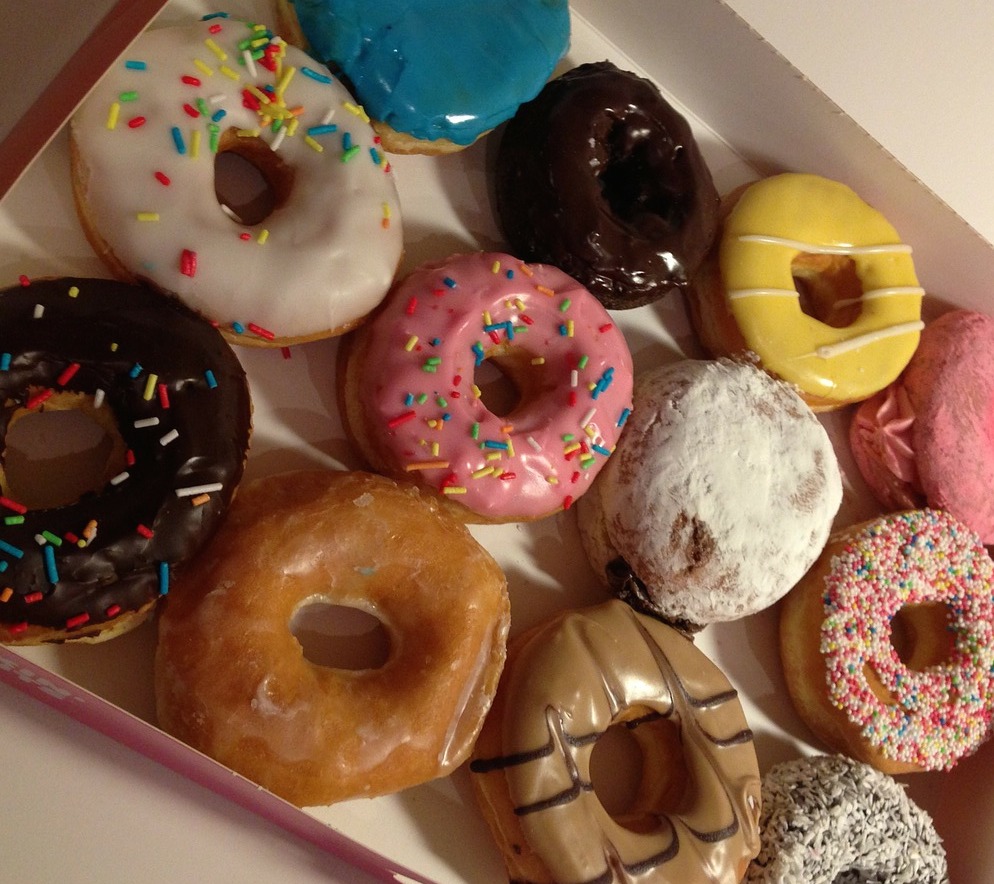
Doughnuts (Donuts) – This is a case of “the hole will make you bigger than the parts”. The only nutritional value you might be able to get from doughnuts is the fat. Then again, what kind of fat is used in industrial manufacturing of those things? Doughnuts are more aptly named donuts (“do nuts”) when surreptitiously brought to the office by a well-meaning (?) co-worker, and left for all to “enjoy”. The sugar boost you get (and the subsequent crash from the insulin spike) you get is sure to make you combative in meetings, and then very much unproductive when you need to be. Just say “thank you, but NOT FOOD for me” next time…

Muffins – Yeah, I know, there’s your full bran muffin, and your “healthy cranberry”, and your “heart smart low fat” stuff, but, really, this is just another calorie bomb loaded with easily digested carbs, fats, and loads of sugar. All too often automatically picked up as a breakfast substitute (though many omit the word substitute, that is really what it is), it is certain to give you a short-term boost along with your coffee. But it will be short-lived, and you’ll crash. Next time you meet one in a coffee shop, say “my fun, muffin, won’t be with NOT FOOD today”…

Cotton Candy – Ok, so you don’t run into this all that often, but in case you do, keep in mind that it is spun sugar, pure and simple. Well, not that pure, and perhaps not that simple, what with the coloring and such. I just felt like putting this one on the list today. So there: Next time you go to a County Fair, or circus, or any such event and are tempted to buy some, keep this in mind. Though a funny coloured tongue is always good for a laugh.

Chips – Well, if you thought this list is about sugar only, you were wrong. NOT FOOD comes under many guises. Never mind that potatoes have been selected over millennia for their starch content (complex carbohydrates, or long chains of sugars), unless you chop up a real potato yourself and bake it in an oven, what you get from chips is, well, anyone’s guess. Especially my favourite, which are so uniform in shape that there can be no doubt they are fabricated that way. And there’s the rub: When’s the last time you saw a tree in which bags of chips grow? Huh? With chips, you get fast carbs (too fast), loads of salt (too much), and so many additives (not necessary). Potatoes in a normal diet is not the worst thing you can do, but chips are definitely NOT FOOD.

That’s quite enough for one day. Especially right after lunch…

The idea is not that you must stop immediately eating such “things”; however, you should develop a perspective on their status as NOT FOOD, and be more mindful when they are proposed to you. Or you order some food and “just take the trio” (which usually consists of chips and a pop!).

Simply accepting the “donated” donuts, or grabbing a muffin with your coffee, or impulse-purchasing chips when you are grocery shopping in a hungry state are the behaviours you need to stop. And to do that, think “NOT FOOD” when you see those items. And move on. You can do much better with real, natural food.

Your taste buds, and the rest of your body, will thank you for it.


Photo from Pixabay.

A Primer on No-brainer Fitness: E

Movement, Daily

Time to get moving!

In case you were wondering about it, or are generally interested in moving more, this is a kind of “Origin Story” for No-brainer Fitness: E (a.k.a. Everyday).

As the E page indicates, No-brainer Fitness: E is a kind of service to help you put more movement, more exercise, and better food (and less NOT FOOD) into your daily life.

It is not like signing up for a gym membership, a fitness cult, er, I mean class, or turning up at exercise bootcamps multiple times per week. It is a highly individual commitment to doing the simplest thing (though not necessarily the easiest) of moving more, by making it a habit.

As such, it is something all of us can benefit from, no matter what your current level of activity might be.

Some perspective

What is the idea behind this daily service?

It came through the realization that, while I enjoy racing triathlons and marathons, true fitness is something that should happen on a daily basis.

Towards the end of an Ironman(TM) race a few years back, I realized the silliness of what we (some 2,700 of us that day in Lake Placid) were doing.

More to the point, I realized how, while a great deal of fun and very demanding, our accomplishment of completing a long course triathlon would have seemed much less to our great-grandparents. Particularly those used to 12+ hour days of tilling fields, cutting down trees, harvesting, and performing a wide range of physical activities on a daily basis.

Going back even further, our hunter-gatherer ancestors had to keep moving to find their food, run to hunt (not to mention avoid being eaten themselves), and generally carried everything they owned on them without the benefit of cars (or modern backpacks, for that matter).

This is not to put on a pedestal that way of living of days gone by. It is simply a realization that nowadays we take great pride in being able to do certain things that, while challenging, would not have seemed so outlandish to our ancestors. (Except perhaps in the gear needed, and choice of venues.)

Let’s face it, modern life is a lot more pleasant. But in becoming “modern”, we’ve lost a key aspect of our animal nature: quasi-constant movement. We’ve also lost perspective on what it takes for us to be healthy: quasi-constant movement, and real food.

Back to now

In an effort to regain some of that perspective, there is a growing movement to be more active, and it leads a lot of people to endurance sports and “fitness training”. And to a large extent, to obsession about getting fit.

But it is often with the wrong focus: to look a certain way, to perform at a certain level, to lose weight…

What we should be focusing on is movement on a daily basis. What we should obsess about is doing some on a daily basis, never staying put for too long at a stretch. What we should remind ourselves is that skipping one workout is not the end of the world, as long as we keep on moving regularly.

The rest will follow, in time.

That’s why Everyday No-brainer Fitness is a service designed to provide advice and reminders to keep moving on a daily basis.

It is what brings it all together: the exercise, the diet, the lifestyle. The E stands for “everyday”, but it could just as well stand for “everything”.  And now it also stands for “explained”.

All it takes is a desire to get started, and a friendly helper to guide you along…

I’m not saying it is easy, but it is simple. It is definitely a no-brainer. And the beauty of it is that you can get some help to get you started, and keep you going.

So that’s it.

If this sounds interesting, if you are ready to sign-up or need some more information, turn to No-brainer Fitness: E, and fill the form at the bottom.


Photo from Pixabay.