Now that’s my kind of conspiracy theory

Fitness, Health, JFK, History

Finally, a JFK conspiracy worth subscribing to…

I recently visited the JFK Presidential Library and Museum in Boston.

I’m no history buff, nor am I particularly into admiring political figures of the past (or present, for that matter). But I must admit that the visit turned out quite fascinating on various levels.

This guy (John F. Kennedy, to be precise) clearly died way too soon. I picked up a few good quotations and a new-found respect for what he tried to do during his brief stint as POTUS.

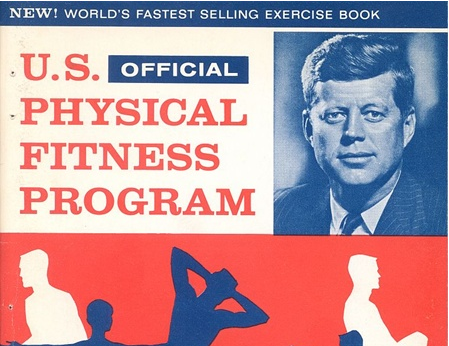
And I got one major surprise in the process, as the picture at the top of this post hints at.

You see, back in the early 1960s, people like JFK were already very concerned about the fitness level of Americans.

JFK re-launched a council on fitness early on in his presidency, and got a fitness program created and disseminated to schools in the US. Later on, he enlisted the help of the artist who was then drawing the Superman comics and asked him to create a special story in which Superman went on a mission to help kids get into better shape.

You could say that JFK was conspiring with a few other people to improve the fitness of Americans. That’s the kind of conspiracy that’s worth talking about.

Keep in mind that this was back in the early 1960s! Already then, there was unease about the fitness level of people, and of kids in particular…
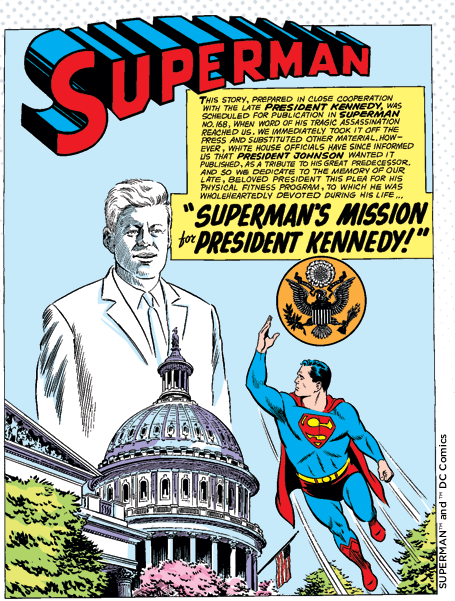
JFK, Superman, Fitness, Health, Exercise

This is done to promote fitness. Let’s hope I don’t get sued.

Some things change, some things stay the same

Sadly, JFK died before the book was published, but his successor got the comics published, as you can see from the other image.

Did it work? Apparently not; the general population, and kids in particular, have been getting less fit, even though elite athletes have been getting better and records have been broken systematically. You could say a wider chasm has been growing in terms of fitness, even as people have been getting wider…

What’s really interesting, however, other than the fact that this was happening already over 50 years ago, is that very little has changed in terms of what is being recommended as regular physical activity. Except perhaps that infamous rope climbing thing (now we beat the crap out of floors with ropes). Sit-ups, pull-ups, push-ups, running, variations on those themes.

We also have a lot more evidence, scientific at that, about how much to move, and at what intensity. Guess what? We should be moving every day. That’s a no-brainer.

Why has it not worked?

That’s a fair question. Consider the simple fact that we’ve known for a long while how to maintain our bodies; we’ve just fallen short of finding better ways to get people moving when they are not.

Perhaps part of the problem is the lack of understanding of how to best promote fitness among kids. Standardized tests and competitions are not the way to go; measuring personal improvements based on heart rate and deployed effort is much better, as Dr. Ratey illustrates in his excellent book Spark, (and about which I provided a brief review a few days ago).

We tend to focus on providing logical, rational, scientific arguments, trying to convince everyone of the importance of moving. Unfortunately, that does not work. Our relationship to effort is one based on emotion, not rationality. That’s the real problem. Something even Superman couldn’t fix.

What can’t be denied is that the last 50 years have seen a continued rise of suburban lifestyles that almost make cars mandatory even as schools have been cutting their physical education courses and made free play practically illegal in schoolyards. Instead of walking everywhere and playing, sometimes rough, now kids are driven and made to behave all the time when in fact what they need is to learn to use their bodies in a fun way and spend energy.

In any case, let’s not forget that we’ve been struggling with this for a while, so a solution is not likely to be easy. But we’ve known for a while that we need to move more, on a daily basis. That remains the key.

Moving On

By the way, the council on fitness still exists, and every few years a new document is created, new guidelines are provided, and so on. It’s an ongoing battle. The documents are getting thicker, perhaps so they can be used for weight lifting some day. The site is there, though I have yet to find useful advice there.

Instead, we should all join the conspiracy directly and get moving. No thinking, no arguing, no rationalizing. Just moving.

Should you happen to be in the Boston area, I highly recommend a visit of the JFK Presidential Library and Museum. If you go, do as I did (and dragged my mom into doing with me): Walk from the nearest T stop instead of taking the bus. That way you’ll keep to the spirit of John “Fitness” Kennedy…

Images “borrowed” from the JFK Presidential Library and Museum Web site, which is visible to everyone, and that I highly recommend visiting to anyone in the Boston area (so please don’t sue me for having used them).

 

Why do we keep talking about dieting and special diets?

Dieting, Diet, Food, Movement

What shall we eat? No more pixie dust, that’s for sure…

Recent posts by one of the very few sources I consider reliable on nutrition prompted me to revisit the theme of diet. So I hope you can stomach one more post on this topic. I’m going to try to make it worth your while by presenting a hint of a solution.

If you have not yet read what Dr. David Katz has to say on the subject, stop reading this right now, and go read a few of his posts instead. I won’t mind. Really.

Still with me? Perhaps you only have a few minutes, so allow me to summarize the current status. (And provide links to his most recent and relevant posts; some are on LinkedIn and may require an account to access.)

Let me make something clear right off the bat:

Dieting does No Good

Dieting does not work. It’s that simple. I’ve written about it myself, and this post by Dr. Katz is quite entertainingly showing that all serious nutrition experts, those not trying to sell you something, say so.

This video about a much-publicized recent study does what journalists always (erroneously) think is better journalism: providing statements from both sides, even though it is a non-debate.

Even having a good overall diet, eating food (not too much) and mostly from plants, is not enough if you are trying to lose a lot of weight, and/or remain healthy for a really long time. For that, you need to exercise, to move, on a daily basis. It is a lifestyle issue, not a diet issue.

But that’s hard work. Are we sure there’s nothing we can do about the food we eat? (Or so we keep asking ourselves.)

In the absence of successful “mainstream” diets, people turn to even stranger diets, like the would-be paleo diet. But even that, as I’ve indicated previously, and as Dr. Katz has put it time and time again (as reported here as well), is part of repeated attempts at making believe we can get fit and slim without doing real work.

So despite dieting not working, why do we keep talking about diet as if it is the solution? Why is it that every so often a new kind of special diet starts and claims to be the solution we’ve been looking for?

Basically, the question is:

Why do we keep focusing on dieting?

Because it is appealing to us.

Most (all?) of us have a tendency to seek easy fixes, magical solutions, silver bullets. I feel this is primarily due to our innate tendency to assign simple cause and effect relationships to phenomena: if this bush moves, that’s probably because there is a tiger ready to jump on me, sort of thinking. In this case: I’m getting fatter, so it must be what I’m eating.

To some extent it is, but that’s not the point. We focus on the wrong culprit at the expense of the white elephant on the couch.

The main aspect of our lifestyle that is different from what our ancestors of even a hundred years ago had to deal with is lack of movement.

Yes, it would be harder to move a lot more; it is effort. But there is more at play:

We are constantly bombarded by good stories that, even though they are scientifically unsound, appeal to our innate need for those causation narratives. Those stories are how modern snake oil salespersons get us time and time again.

If, as I surmise, this is a big part of the problem, it also suggests a way to fight.

A way forward?

While I generally agree with Dr. Katz that we should “grow up” about it, and that we must make the effort to eat well, along with exercising, not smoking, etc., I think we need a pro-active approach as well.

Since the ease with which stories can be created about special diets is part of the problem, perhaps a good story could be part of the solution. We need new narratives to replace those of the pixie dust diets, successful precisely because, although they don’t stand up to scientific scrutiny, they appeal to us through simple (simplistic) stories. We can keep telling ourselves, and others, the well-articulated lies we were told by the dieting peddlers precisely because they are simple enough.

On the other hand, the “I eat food, not too much, mostly from plants” story requires more explanations when you try to discuss it with others, and few of us have the knowledge to feel comfortable doing that.

There should not be a need for more explanation; our ancestors did not feel such need. They just ate what food they had.

The problem nowadays is that we have way too much, and it is all way too rich for our own good. In a see of contradictory advice and the occasional about-face of scientists themselves (which is even harder to explain for non-scientists), we all feel a need to justify our choices.

What better way to justify those choices than a good story?

So that’s the narrative, the story, we need to work on, instead of just de-bunking the others (not that there’s anything wrong with de-bunking). Allow me to have a go at a first draft.

A proto-story for healthy living

Begin Story

I am a human being, an animal that has evolved over millions of years to actively seek and eat a wide variety of plants and other animals.

Lately I’ve been extracting even more nutriments from my environment by cooking and domesticating my food sources. That’s great progress.

But my body has not yet evolved to remain healthy by staying put all the time and eating heavily processed stuff. Yes, stuff: there is no better word for some of what our modern society provides.

So I need to move on a daily basis, a lot, and eat foods that are as close to their natural forms as possible. That means different things to different people, but to me it means plants and some animals that have not strayed very far from their natural lifecycles. When I eat that way, I find that I eat less because I feel full sooner. And the more I move, the more I crave good food, and the better I feel.

If machines and chemical processes other than the digestive systems of other animals have been involved, I am very careful with how much I consume.

And always, no matter what I eat, I make sure to move a lot. Everyday.

End Story

That’s it. C’mon, it’s not that hard to memorize. Give it a try. You can even substitute something for “plants and animals” if you are so philosophically inclined. No problem.

Or comment with suggestions to improve it…

But, in any case, I have a final piece of advice for you about the claims of Diet Peddlers:

Diet, Exercise, Movement, Everyday

What to do when somebody tries to convince you their dieting approach is going to work…

Top picture from Pixabay.

What makes a good coach? Part 3

Coaching, Triathlon, Competition, Ironman

Coaching sports like running and triathlon: a league of its own.

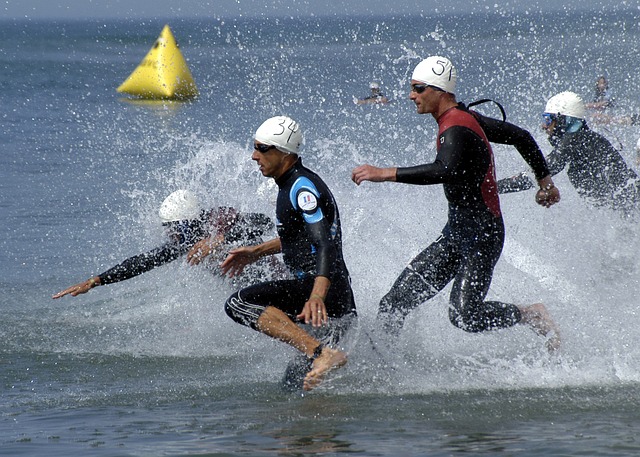
Back in March (of 2014), my wife and I attended a triathlon expo at MIT. (It had nothing to do with MIT; it just happened to be held at their sports facilities. MIT has a very nice pool, by the way.)

We were there mostly to buy some equipment and supplies in preparation for the season. But we had a couple of nice surprises once we got there: first, we got to meet one of the original ironman finishers; second, we got to listen to Siri Lindley give a talk about coaching. (Well, she spent a lot of time talking about her career as an elite short-course triathlete, but the part about how she got there, and how she herself was coached, was informative.)

For those of you who don’t know her, Siri is coach to Mirinda Carfrae, the current Ironman World Champion (she’s been the champ three times so far) and championship course record holder among women.

So this post is really about coaching adults in the context of sports like running and triathlon, and, more specifically, the coaching of fairly serious athletes (or “intense” athletes, because if not elite athletes, you have to be intensely into training in order to pay for the services of a coach). Combined with the previous post on my personal experience, and the one about coaching in general, it is the background material I’ll need to conclude the series in Part 4.

Now, I have to admit that I’m no groupie of elite athletes or their coaches. I prefer to do, instead of watching or reading about them. We were not at the event in order to listen to Siri. We just thought: “We’re here, and we have a bit of time, so let’s sit down.”

It was time well spent, nevertheless, not just because it confirmed many of my own conclusions about what makes a good coach, and what makes a good athlete. I’ll list those attributes later, but for now, allow me to give a few key notes from her presentation.

Focusing

Siri only coaches a few athletes. I seem to recall she said 12, but it definitely was something between 10 and 15.

This makes sense at such an elite level as top Ironman competitors, since the pros and elites need specialized coaching, and are willing (or able) to pay for it.

The point, however, is not how much Siri gets paid by her athletes, but what she emphasized: She feels that only with so few athletes can she really provide good coaching.

It stands to reason that the more athletes one has to coach, the less time and attention can be given to each. That’s why joining a club is an excellent way to find a bit of support and coaching advice, but you get less personal attention that way.

For truly personal attention, you need to be one of few athletes being coached. Beware of coaches who work for a team or club and also coach more than a handful of athletes: You may be getting cookie-cutter advice and training programs that masquerades as individualized coaching.

Customization

Because she only coaches a few athletes, Siri is able to customize the training regimen of each so as to maximize the effect of the training. Or is it the other way around?

One thing is certain: She does provide very specific attention to each of her athletes; they each have their own season plan, and training session plans, and every plan in between.

This is key because, although the training principles are the same, and the general physiology is the same for all humans, no two persons react entirely the same to training on a daily basis. This is due in part to small differences in biology and in large part to previous training, current state of being, and psychology. That is normal.

Similarly, Siri does not treat all of her athletes the same, either during training or competition. To my surprise, she admitted acting almost like a cheerleader to some, while to others she is the quiet and wise adviser, and to others she can even be the forceful (not to say harsh) boss telling them to get their acts together.

This is squarely in the psychology realm: We are all different in terms of what we need to get, or keep us, in the correct frame of mind to perform. Elite athletes are no different (and perhaps even more sensitive and insecure at times, because of the added pressure of making a living out of sports).

The key point: no two individuals need exactly the same thing at the same time. So personal attention is mandatory for good coaching.

Knowledge

Siri was a top competitor in Olympic distance triathlon. She got there through some good coaching, but also through a lot of grit and determination.

However, there is no need to have been a top athlete to be a good coach. That’s a truth that’s often hard to believe by those who have never really been coached before. But it is true.

What is less obvious to most wannabe triathletes is that, unlike most top triathletes, even those who later make a living out of coaching, not all great athletes make good coaches. Only a few really pick up the fundamentals of coaching, and understand more than what works for them. Because what works for you is likely not what works for others. And a good coach knows enough to adapt to what each athlete needs.

What should a coach know?

In triathlon, it gets tricky, because of the three sports. A good triathlon coach must know enough about the bio-mechanics of swimming, cycling, and running. That’s in order to be able to work on form, not just intensity, in all the three sports while making sure to prevent injury (as much as humanly possible). Ideally, a good coach is able to bring about the necessary changes to technique and form to optimize performance.

But a good triathlon coach must also know about how those three sports are put together in triathlon, and how the body reacts to going from one to the other, and then on to the other.

That means having some first-hand experience in the sport is a good thing. Perhaps necessary. But being a top competitor is not. It can even be a detriment, as I think it is for fitness instructors and personal coaches, because of the “hey, it worked for me, so it will work for you as well” factor. (Or the “look at me, I was a champion, so I must know what I’m doing” factor. In either case, it is a fallacy.)

Also, understanding the physiology, psychology, and science behind training is mandatory. Too many coaches simply push their athletes to the breaking point, under the old philosophy of “no pain, no gain”. For some athletes, this leads to breakthroughs. For most, it leads to breakdowns. That old notion is now dismissed; there are much better ways to train.

The coach has to know when to push, and when to hold back an athlete. And with pros, elites, and would-be top competitors, the holding back part is often more critical. And difficult.

Planning

Finally, a good coach, much like Siri indicated, must be able to understand where his or her athletes are at, and where they aim to get, and plan a reasonable path from one to the other.

That’s precisely how Siri started working with Mirinda Carfrae, according to the talk she gave back in March. Although Siri had not done iron distance races herself, she was able to understand what physiological changes would be needed, and to chart a course to make them happen. And with an athlete like Mirinda Carfrae, who was hardly new to the sport, that was a pretty tall order.

Which of course begs the question:

What about athletes?

Being a good coach is only part of the equation. The athletes also have to do their share of the work. And with all the training and intensity, that part is of course the hardest.

But there is one aspect in which coaching for running and triathlon, and coaching in general, differ a great deal: Pros and elites (and triathlon freaks) are highly motivated, so they don’t need to be coaxed into doing the workouts. More often than not, they have to be calmed down, and forced to take rest. Not at all like the majority of folks trying to get into better shape in order to be healthy, who have to be convinced off the couch.

So a coach to such athletes does not need to cajole them into showing up at training, or find ways to keep them interested in the sport. But they should also not burn them out, or make them hate training.

On their side of things, athletes who want a running or triathlon coach and are serious about it must do one thing to deserve their coaches: Listen.

By this I mean to fully engage themselves into the process, and follow their coaches’ advice. Not argue, not go looking for second opinions, not say “I know what I need”.

Perhaps that holds true for any kind of athlete, and any kind of sport. But let’s leave that for the next, and final, post on what makes a good coach…

Picture from Pixabay.

Revisiting the “The Paleo Thing”

Paleo, Diet, Movement, Daily

Hunting appears to have defined us, but it is only part of the (pre)history.

Since writing the “Let’s do the Paleo Thing (yeah!)” post a couple of weeks ago, I came across a highly relevant article from National Geographic.

So I thought I would share the link, and cherry-pick some of the key passages to save you time. It is well worth the read, so I urge you to not just read this post.

Now, although the article was actually published before I wrote my blog post, I must insist that I had not read it.

It just so happens that the article makes pretty much the same arguments I did, only with more smart people being quoted in the process:

1) The Paleolithic is defined by more than what humans ate, and the main problem is the change in lifestyle, not what we eat:

“Studies suggest that indigenous groups get into trouble when they abandon their traditional diets and active lifestyles for Western living. Diabetes was virtually unknown, for instance, among the Maya of Central America until the 1950s. As they’ve switched to a Western diet high in sugars, the rate of diabetes has skyrocketed. Siberian nomads such as the Evenk reindeer herders and the Yakut ate diets heavy in meat, yet they had almost no heart disease until after the fall of the Soviet Union, when many settled in towns and began eating market foods. Today about half the Yakut living in villages are overweight, and almost a third have hypertension, says [biological anthropologist William Leonard of Northwestern University]. And Tsimane people who eat market foods are more prone to diabetes than those who still rely on hunting and gathering.”

“Many paleoanthropologists say that although advocates of the modern Paleolithic diet urge us to stay away from unhealthy processed foods, the diet’s heavy focus on meat doesn’t replicate the diversity of foods that our ancestors ate—or take into account the active lifestyles that protected them from heart disease and diabetes.”

2) Knowing exactly what our ancestors ate is nigh-impossible:

“But is it true that we all evolved to eat a meat-centric diet? Both paleontologists studying the fossils of our ancestors and anthropologists documenting the diets of indigenous people today say the picture is a bit more complicated. The popular embrace of a Paleo diet, [paleoanthropologist Peter Ungar of the University of Arkansas] and others point out, is based on a stew of misconceptions.”

3) While meat was indeed part of the diet of our ancestors, the use of fire to cook food was perhaps more important in the greater scheme of things, and we definitely were eating plants, including grains, to survive:

The real Paleolithic diet, though, wasn’t all meat and marrow. It’s true that hunter-gatherers around the world crave meat more than any other food and usually get around 30 percent of their annual calories from animals. But most also endure lean times when they eat less than a handful of meat each week. New studies suggest that more than a reliance on meat in ancient human diets fueled the brain’s expansion.”

“So how do hunter-gatherers get energy when there’s no meat? It turns out that “man the hunter” is backed up by “woman the forager,” who, with some help from children, provides more calories during difficult times. When meat, fruit, or honey is scarce, foragers depend on “fallback foods,” says [paleoanthropologist Alison Brooks of George Washington University].”

““There’s been a consistent story about hunting defining us and that meat made us human,” says Amanda Henry, a paleobiologist at the Max Planck Institute for Evolutionary Anthropology in Leipzig. “Frankly, I think that misses half of the story. They want meat, sure. But what they actually live on is plant foods.””

“If [Harvard primatologist Richard Wrangham] is right, cooking not only gave early humans the energy they needed to build bigger brains but also helped them get more calories from food so that they could gain weight.”

Oh, and by the way, we have kept evolving, as can clearly be seen by looking at the various populations around the world, and things like lactose tolerance into adulthood:

“All humans digest mother’s milk as infants, but until cattle began being domesticated 10,000 years ago, weaned children no longer needed to digest milk. As a result, they stopped making the enzyme lactase, which breaks down the lactose into simple sugars. After humans began herding cattle, it became tremendously advantageous to digest milk, and lactose tolerance evolved independently among cattle herders in Europe, the Middle East, and Africa. Groups not dependent on cattle, such as the Chinese and Thai, the Pima Indians of the American Southwest, and the Bantu of West Africa, remain lactose intolerant.”

“What’s more, she found starch granules from plants on fossil teeth and stone tools, which suggests humans may have been eating grains, as well as tubers, for at least 100,000 years—long enough to have evolved the ability to tolerate them.”

In conclusion (because this is already getting long):

“We have gotten so good at processing foods that for the first time in human evolution, many humans are getting more calories than they burn in a day. “Rough breads have given way to Twinkies, apples to apple juice,” [Wrangham] writes. “We need to become more aware of the calorie-raising consequences of a highly processed diet.””

“It’s this shift to processed foods, taking place all over the world, that’s contributing to a rising epidemic of obesity and related diseases. If most of the world ate more local fruits and vegetables, a little meat, fish, and some whole grains (as in the highly touted Mediterranean diet), and exercised an hour a day, that would be good news for our health—and for the planet.” (Emphasis mine.)

Reference:

The Evolution of Diet, by Ann Gibbons, National Geographic, September 2014, p. 35-53

Picture from Pixabay.

What makes a good coach? Part 2

Coaching, Athletes, Sports, Training

Coach: More than a timekeeper.

Last time, I wrote about the best coach I ever had. (If you haven’t read that post, feel free to take a moment now to do it; if you don’t have time, I’m about to provide a short summary.)

If you recall, this person was able to progressively take me (and many others) from beginners to sufficiently skilled players, both as individuals and as a team, to win a regional championship. How?

  • He made showing up at practice a no-brainer (we were actually looking forward to practice, instead of dragging our feet to it);
  • he made learning and developing our skills and physical condition fun through challenges we could achieve with reasonable effort (and some friendly competition);
  • he provided advice and guidance during games, to make sure we could perform our best;
  • he chided when absolutely necessary, and congratulated when applicable.

To elaborate a bit more, in my estimation this coach had the following attributes:

  • He knew the sport inside-out, and was excellent at teaching technique as well as game tactics and strategy.
  • He was a great planner for both individual training sessions and the overall season.
  • He paid attention to individuals’ talents and guided each of us so we would progress as rapidly as possible.
  • He built relationships with his athletes on the basis of mutual respect for our roles and responsibilities.

No doubt he was well served by many years of experience as a coach, but that’s still a tall order.

Yet isn’t it what all coaches do? On the other hand, is it all that one should expect from a coach? It begs the question:

What’s a “coach,” really?

A coach can, and must, be many things. But people generally agree about the following roles that a coach can fulfill:

  1. Teacher / Instructor / Technical Expert
  2. Planner / Scheduler
  3. Motivator ( / Cheerleader / Disciplinarian)
  4. First Aider ( / Medical Advisor)
  5. Basic Nutrition Advisor

I put a few items in parentheses because they represent certain expectations of coaches which I feel are not reasonable, or smart. For instance, unless the coach is a medical professional, the advice provided really should be very limited, and always conclude by telling the athlete to seek the opinion of a healthcare professional of the relevant specialty (or a GP with an interest in physical activity, though any GP should be professional enough to refer instead of just saying “stop”).

As to being a disciplinarian, really, that should fall in another category such as legal and/or sport regulations. The coach is expected to teach the rules of behaviour and sportspersonship, not to enforce them. (However, the coach must abide by such decisions as rendered by referees and disciplinary bodies, and support such decisions. But I digress.)

Finally, let’s hold off on talking about cheerleading for the moment.

Do I believe a coach, a good coach being implied, has to do all of that?

My answer is: It depends.

What most adult “athletes” seem to need

Nowadays, you see a lot of coaches who are primarily fitness instructors, in a very limited sense of showing techniques and guiding through workouts, and motivators, bordering on cheerleaders. Especially in gyms, the kind that one joins in order to lose weight (oh, and get into better shape as well, but primarily to look better).

This is fine for the majority of people who dabble in spurious gym attendance and faddish, er, novel, exercise classes. It might even be exactly what some people need. But it might also explain a great deal about the tendency for people to sign-up for, and then drop, such classes and gyms.

You see, there is a big difference between being able to illustrate how to do something, and being able to teach someone how to do it right, possibly by modifying the movement and gradually bringing about the correct form. That’s teaching, not instructing.

And there is a big difference between cheering someone on while they are exercising, and making exercising so much fun (or at least enjoyable) that they’ll keep coming. That the difference between being a cheerleader, and being a good motivator.

More to the point, coaching should involve personal attention to the needs and progression of the individual. Being instructor to dozens of people at the same time, seeing up to hundreds of fitness enthusiasts each week, is not the same kind of coaching as taking a few individuals through the skills and fitness development they need to complete a triathlon, for instance.

A lot of those instructors and personal coaches come from a relatively recent discovery of the benefits of being more fit, and keep on going by becoming coaches themselves. Their personal experiences (“I went from so many pounds, to looking like this, so you can do it, too!“) speaks to hopefuls, and gets them hooked. Often enough, a group dynamics also forms that further motivates participants, which is what gyms and classes count on.

But that kind of motivation is not, ultimately, what will keep folks showing up at the gym, or get truly fit and healthy. What is needed for that is a real Purpose, not just rapidly fading enthusiasm.

And beware in particular of any coach who offers more than a generic level of nutrition advice. Especially if they start talking about supplements, or some strange cleansing diet. A coach ought to know enough to provide some guidance as to how to eat well, but unless he or she is a nutritionist, it should only go so far.

I am not (really) trying to put anyone down; I’m simply trying to point out that there is a wide range of people having claims on the title “coach,” and that not all of them are the same.

Does that mean only certified coaches should be able to call themselves coaches? (Let’s forget for a moment that there are numerous bogus certifications out there…) Certainly not: You can find excellent coaches that have not bothered to obtain certifications by recognized sports bodies. Especially in sports like running and triathlon.

What matters for adults, who have the life experience to make their own decisions, is that there be a good approach to coaching, one that suits their own needs.

There is, however, one exception to the “certification not required” statement:

What kids need

Childhood is a critical time in the learning of skills and fitness principles.

Unfortunately, too many kids are turned off from sports through old-fashioned (and simply wrong-headed) gym classes. Coaches can play a role there, if the kids are also taking extra-curricular activities like soccer, football, baseball, or hockey, but that’s an uphill battle if gym classes set the wrong tone.

Worse than gym class, however, is when kids are being yelled at by improvised coaches who focus more on performance than on development.

Pretty much every parent wants his or her kids to be healthy and to move, so participation in little leagues is pretty strong. Which means the teams need coaches, and lots of them. Hence the parents are asked to help out.

While it is commendable of parents to want their kids to move (they seem to be applying something they understand intuitively, yet don’t do themselves), putting them into the hands of just about anybody is not a good idea. Adults don’t see team sports the same way as kids do, and so emphasis is often put on competition instead of fun. (And I’m not even talking about parents with dreams of their kids becoming professionals.)

Coaching, Sports, Movement

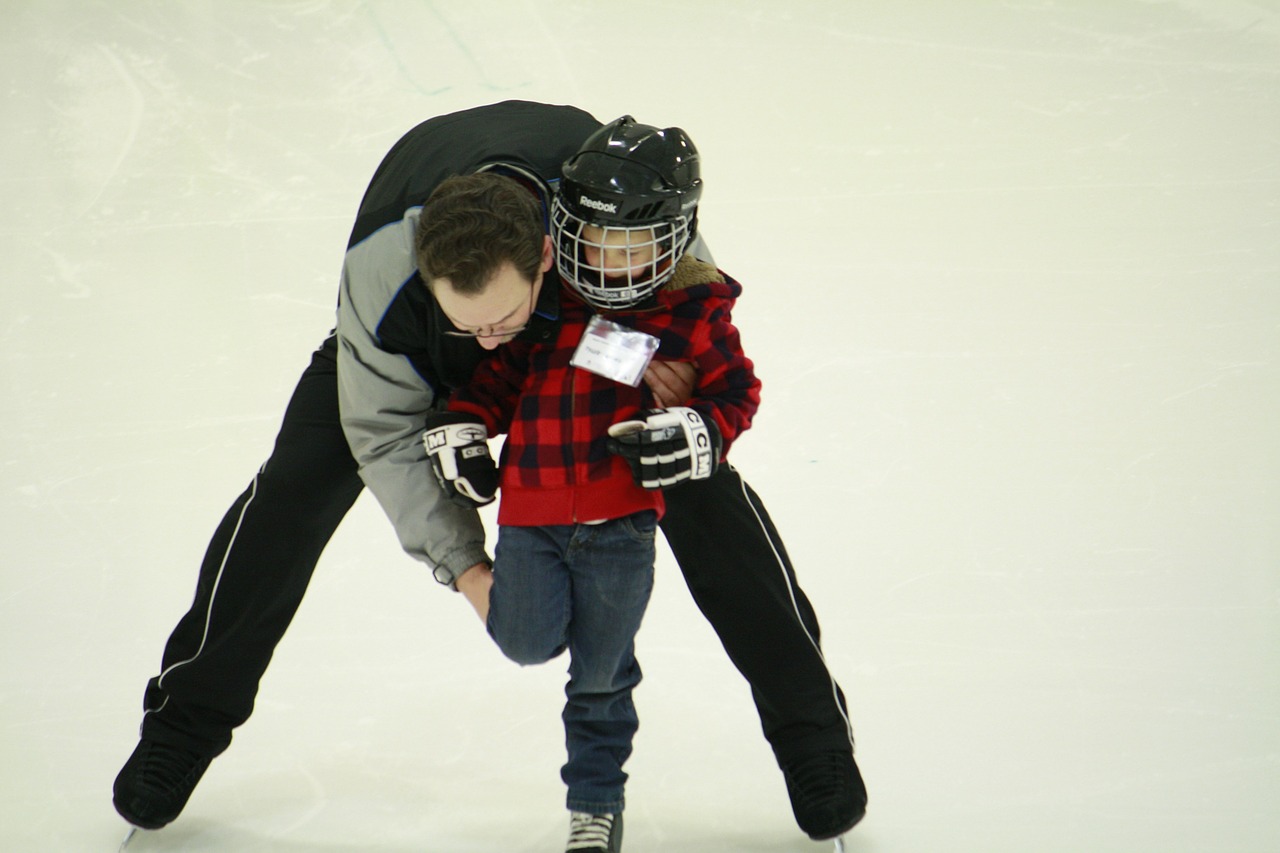
Coaching kids: not the same as coaching adults.

That is something certified coaches are trained to deal with. That’s why I would much prefer there be fewer teams, with good coaches, than large leagues with yelling parents pretending to be coaching the teams.

Ok, I’ll admit, even some certified coaches are pushing the performance aspect too much, and much too soon. We are all human, it seems. But it is something that coaches are drilled about, and do know better, so a friendly reminder from time to time wouldn’t hurt.

Ultimately though, I feel it is primarily the job of parents to encourage their kids to move and learn to use their bodies. For that, nature has equipped us with a desire to play, to have fun. Organized sports and gym classes can be a part of that, but not at the cost of kids having fun.

The best thing one can do with kids is be a good example by moving as much as possible, and play with them (or let them play and organize their own games, that way they also learn to socialize). If you insist on organized team sports, make sure the coaches are certified and have the right approach to your kids’ age group and development level…

What a really good coach does

I’ve laid the foundation, put in place a few caveats, and even talked about kids. Together with the first post, you should start to get the picture of what a good coach’s actions and behaviour should be.

Next time, I’ll focus on what makes a good coach for adults interested in getting fit, and/or picking up a fun sport like triathlon.

Stay tuned.

Photos from Pixabay.