The secret to a bright and yummy morning

Food, Eating, Health, NOT FOOD

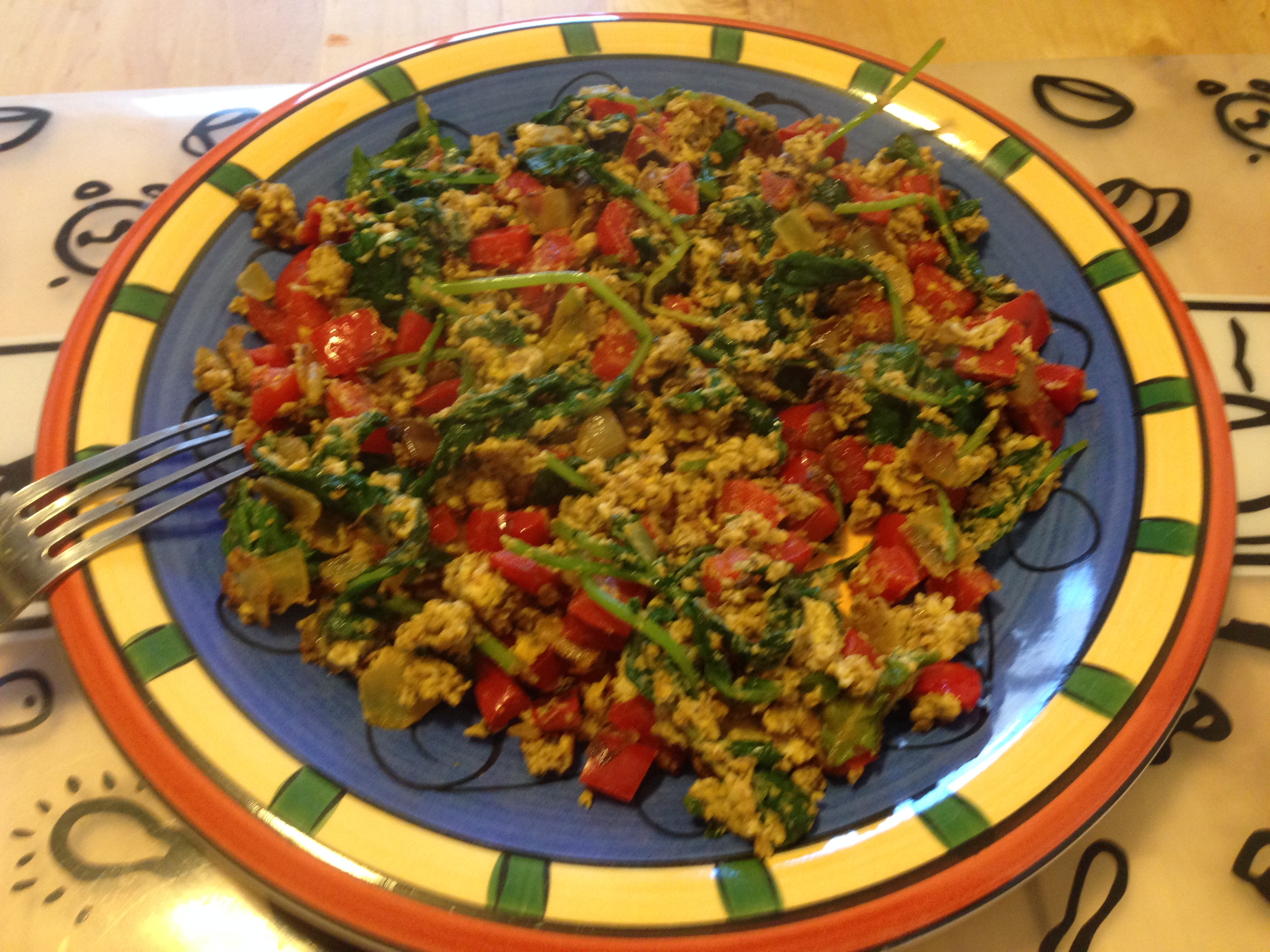
Look at those colours!

Wanna know the secret?

Here it is: There is no secret.

Just like for healthy eating, the kind of eating that allows your body to optimally do what it evolved to do. There is no secret that will make you healthy.

There are just a bunch of things we tend to forget in the hectic pace of our modern lives.

So this morning, as I was reminding myself of some of them, I thought I might as well write them down.

No, there won’t be a recipe. See below to figure-out why.

The things we forget about eating in a way that allows our bodies to be healthy

Don’t worry, it’s actually a short list. And it should look familiar.

  1. Cook food at home. Meals you actually prepare, not eat at a restaurant or order in, or take out of a box to pop in the microwave oven. (Nothing wrong with the microwave oven, by the way.) And while you are at it, make some extra to take to work as your lunch the next day, instead of hitting the food court. (That’s where the microwave oven comes in.)
  2. Start from real, whole ingredients, that have not been processed into some barely recognizable version of something that grows or moves of its own volition. Mix and match as you feel, letting the natural flavours do the job.
  3. It is not the specific ingredients that matter. For instance, good stuff like what I had for breakfast this morning (eggs, kale, onions, garlic, turmeric, red peppers, coconut oil) are just that: good stuff. No magic involved, no super food.
  4. Take the time to sit down and eat. It is when we rush that we make the most eating mistakes. Lack of time means bad decisions like food that has been processed, but as well an added stress to our entire bodies, making it harder to process the food properly.
  5. Minimize the NOT FOOD part of your daily intake. That’s just common sense, but the problem is that we often mindlessly put stuff (and by “stuff” I really meaning things that just take space without providing nutritional value) into our mouths.

That’s it. If you keep this in mind, you’ll let your body do its job with minimal impediment.

And you’ll be having a lot of bright and yummy mornings as well. Especially if you exercise regularly, either before or after breakfast. Enjoy!

IMG_1065P.S.: In case you were wondering, there is no recipe in this post. This is not a blog about food.

Photos by me. This morning.

Take a good look at Future You

Exercise, Future You, Sedentary, Movement, Daily

When something is done well, you might as well use it. But make sure to credit the source.

Why don’t we exercise enough?

Is it because we are too lazy? Not disciplined enough? Unable to stay motivated?

If you’ve read my most recent post, you know those are essentially the questions we were left with at the end. Because we have all the evidence we need about why we should exercise.

If you’ve read anything else on this blog in the past, you know the answer is not in motivation or discipline, two strategies that will fail you eventually, or drive you (and many around you) nuts.

It is pretty clear that only the strongest Purpose can keep us going in the long term. Yet for most this sense of Purpose remains elusive.

So while it seems we have tendency to be lazy, the truth is slightly different. You could say we are “wired” to be lazy, to economize our efforts, and only the strongest of wills can hold firm on their self-commitments.

By the way, this is not a figment of my imagination, or some wild theory I just came up with. It comes from research in behavioural economics, which others could probably explain better than I can.

But I’m going to explain it to you in my own words. With the help of visuals from a really good talk I recently watched on YouTube. (Even if you think you don’t have time, if you are serious about understanding fitness and long-term health, you should be watching that talk. After reading this post.)

The Truth

Most of us have a strong discounting rate when it comes to our “Future Selves”. (That’s a term borrowed from economics, and it is highly accurate in meaning. However, most of us are not bankers and economists, thankfully. So…) To put it more simply, I hope, the problem is as follows: when you think about the way Future You will be, the possibility of a healthy and active Future You is not seen as important enough because it is too far into the future.

Even though you want to be healthy and fit (who doesn’t?), the Future You is too remote, too distant, too hard to see clearly. The present, and very near future, occupy all that your mind can really consider and act upon. No, I’m not saying we live only for the present, but we have a strong bias in favour of the short-term instead of the long-term.

Those of us who have a much stronger Purpose typically enjoy a stronger sense of that Future Self. In essence, to them it is easier to keep their eyes on the prize. (Back to our economics/finance terminology, a stronger sense of the Future You comes from having a much smaller discounting rate). In other words, a strong Purpose can be understood as considering the distant future as equally important, or even more important, than the present or near-future.

Let’s see how this works

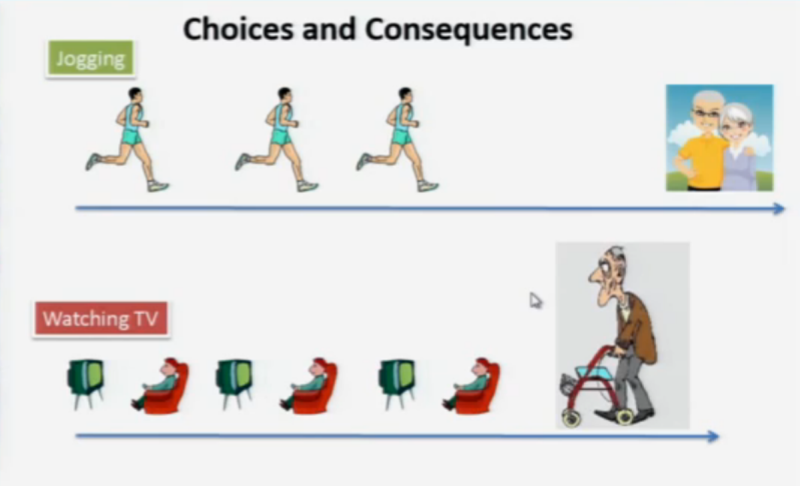
Look again at the image at the top of this post.

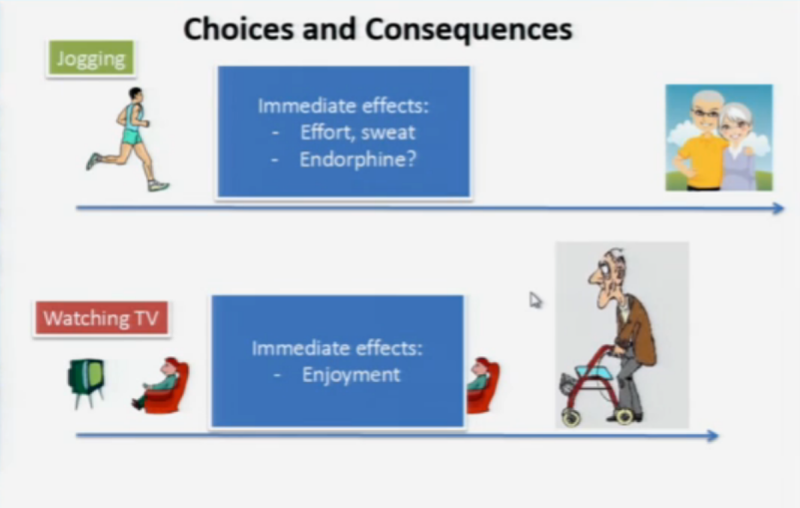
You have two pictures of Future You: one that is healthy and fit, and one that is frail and, probably, suffering from some illness(es). The road to each Future You is a series of short-term actions, choices that happen everyday, with their specific consequences:
Exercise, Daily, Health, Fitness

Two images of Future You…

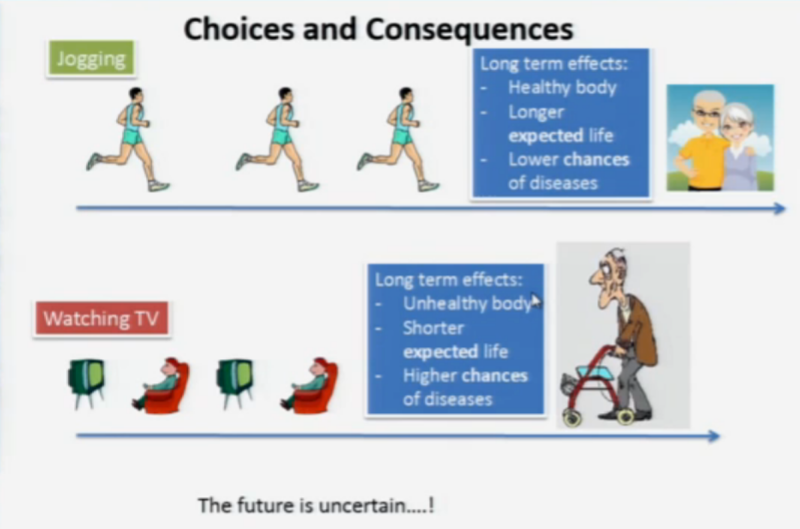
Although there is no absolute certainly about the outcome, we know for sure what the odds are:
Exercise, Fitness, Health

Feeling lucky, punk? It is all about playing the odds… I know what my money is on.

Take a good, hard look at those two Future You. Can you see them well? Which do you want to really be Future You? I bet I know.

So what happens? Why is it still not a complete no-brainer to exercise regularly?

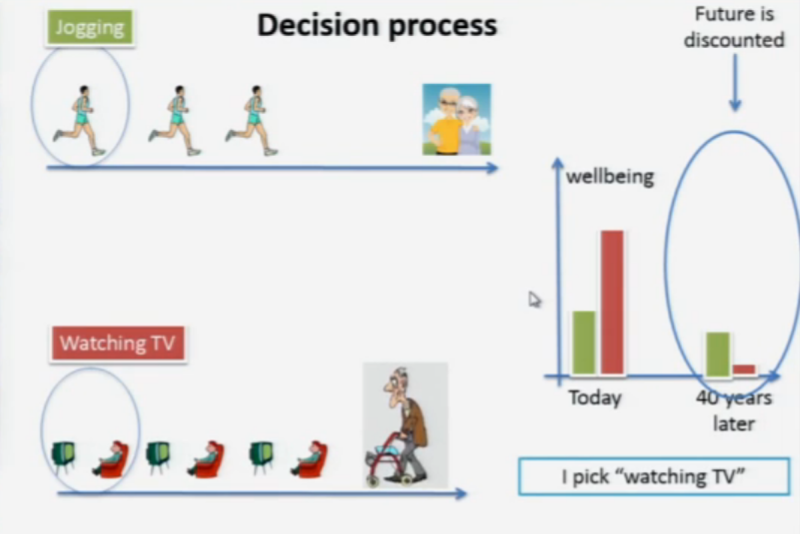
Well, each of us considers those futures against the present. It is a decision process in which you pit Present You against Future You. At least in terms of enjoyment:
Health, Fitness, Exercise, Daily

If the future appears not important enough, you are likely to pick doing nothing.

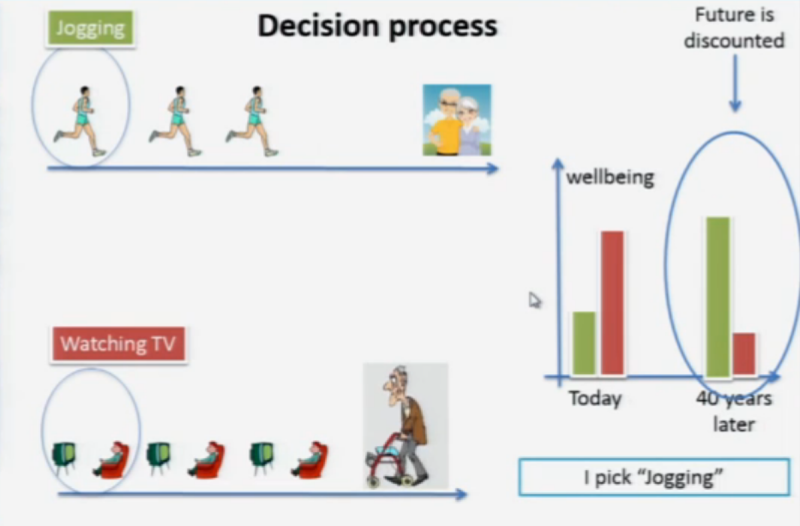
Conversely, if the Future You is clear enough, and important enough, your choice would be otherwise:
Health, Fitness, Exercise, Daily

If Future You is “important” enough in your mind, you will act accordingly. Most of the time. Well, often enough.

That’s basically it. How well you can see Future You, and how you manage to keep Future You in mind on a daily basis, influences how you behave. How much you are eager to exercise regularly.

This works whether Future You is simply a healthy and active Old You, or an incredibly fit and muscular Two Years From Now You, or Winning A Race in 6 Months You. Future You is what you envision yourself to be like at some point in the future. Personally, the only Future You I think is truly worth having in mind, having as a Purpose, is Healthy And Active Old You. Which should make You exercise regularly, and in a reasonable way…

Future You, which becomes the source of your Purpose, is not the only contributing factor to exercising regularly, as we’ll see next time. But it is a necessary beginning. Without it, you must fall back on motivation, or worse, on discipline.

The good news is that you can improve how Future You influences Present You. You need to look at Future You regularly.

So keep a picture of Future You where you can take a good look at it everyday, just as you head out to exercise…

_____________

Image credits: All images in this post were shamelessly lifted from an excellent lecture given by Michele Belot, Professor of Economics and Director of the Behavioural Laboratory at the University of Edinburgh (BLUE), as the third lecture in the 2014 Our Changing World series, entitled “Behavioural Economics and Health Behaviours“. It is a really good lecture, about which I will talk again in my next post. And from which I will shamelessly lift more images.

Do we really need more evidence?

Exercise, Daily, Fitness, Health, Diet

You can rejoice in the high level of confidence of at least one thing: Exercise is good for you.

The results keep pouring in.

The titles are often exaggerated, sometimes misleading, occasionally downright wrong. But that’s journalists for you. You gotta read beyond the headlines.

Even without reading beyond the headlines, however, the general trend is very clear: Exercise is good for you. Even in large doses, it is certainly better to be exercising than not exercising at all.

Thus the question I ask in the title: Do we really need more evidence?

As a scientist, I understand that there cannot be absolute certainty. It is a matter of “degree of confidence.” And it is difficult to tease apart the effects of various lifestyle decisions in something as complex as health. So I cannot begrudge researchers wanting to do more research, needing to clarify (or identify) causality among the sea of correlations that past research has brought to our attention.

But no matter how much clarification and specific causality determination still remains, no one is claiming that exercise is NOT a good thing for you. On the contrary. That’s pretty much the best, most agreed-upon, common denominator to all the research out there (on the subject of fitness and health). There is a lot of confidence.

So for you and me, normal folks, it truly is a no-brainer: Exercise. Move. Regularly. Everyday. The more, the better.

But because it is always fun to do (and it provides good fodder for a blog), here are a few recent conclusions from articles published on the subject.

Answers

First of, it really looks like exercising is not only good for increasing the odds of long-term health, but it is also a really good idea if you are sick or have suffered from a serious illness.

Then, if you are getting older (and who isn’t?), exercise can really help keep your head in better shape, not just your body.

Speaking of which, I’d be remiss not to mention this really interesting piece of research about the effect of diet, particularly greens, on cognitive health. I do love my greens, even though I promote exercise first and foremost.

There’s a passage in the summary of that particular article that is worth copying here:

They followed participants for 2 to 10 years, assessing cognition annually with a comprehensive battery of 19 tests and adjusted for age, sex, education, smoking, genetic risk for Alzheimer’s disease and participation in physical activities when estimating the effects of diet on cognitive decline.

By the way, when a researcher talks about “adjusted for (…) participation in physical activities” to estimate the effect of diet, it means that exercise was already understood as an important contributor to health (high correlation between exercise and health) and what is being looked for is the remaining contribution of diet. Get it? Exercise comes first, diet comes later. Just sayin’.

In closing, let’s go back to one of the earlier things I hinted at: Even if you do “too much” (and the exact definition of “too much” is unclear), you are still better off than if you are not doing any. So exercise, regularly. Vigorously at times.

That’s a no-brainer for which your body (and your brain) will thank you later.

Questions

You think my section titles are backwards? Answers first, then questions? Nope. Answers always lead to other questions. At least if you are serious about asking questions.

So let’s.

Do we really need more evidence that exercise is good for us? Ok, we know the answer to that. It is a resounding “no!”

Do we really need more evidence in order to get us moving more? That’s a different question. The answer is also, probably, no.

So what do we need, if not evidence, to get us moving more? That’s a far more intriguing question.

Perhaps it has to come from our emotions? Perhaps it is simply a commitment? The big stick of Discipline, or the easy persuasion of our Purpose?

I don’t know for sure, and it probably depends. And it is a good question to finish with.

One thing is certain: It is what I’ll spend my next post talking about…

Picture from Pixabay.

Do this to be healthier and save money

Supplements, Diet, Everyday, Health

That’s what Echinacea looks like. Pretty. But you don’t need to eat any.

Have I got a good and easy deal for you today! Guaranteed results! Free of charge, too!

A simple action you can set in motion today, and easily maintain for the rest of your life. One that will pay handsome dividends both in terms of your health, and in your wallet.

What is it? Here it is:

Never buy dietary supplements ever again.

Simple enough, right?

I know, I know, you want to tell me that you already don’t use that stuff, so this advice does not apply to you.

Well, the statistics are pretty clear on the subject: About 20% of us regularly buy some sort of supplement, be it protein or herbal “stuff” with wildly exaggerated properties, none of which have been scientifically demonstrated. The industry of supplements is estimated to be raking in some $5 billions annually. Taken together, those numbers mean that if none of you admit to taking some, some of you are lying.

By the way, I’m not talking about pills of vitamins or minerals. To be fair, unless you have a medically diagnosed condition that requires you to supplement your nutrition with vitamins or minerals, they are also a waste of money. Were I to include them, the proportion of those who take some sort of supplement on a regular basis would go above 50%. And the value of the industry would go to some $30 billions, most of which wasted by consumers because they simply don’t need any supplements.

No, I’m talking about the large number of products, supposedly based on plants, which are touted as cures or insurance for a wide range of diseases or problems. And for which there is no credible scientific support.

Worse than that, however, is the fact, well demonstrated scientifically in this case, that the supplements often don’t even contain what they claim to contain.

So, to put a big nail in the coffin: Even if you insist on believing that Echinacea, for instance, has some near-miraculous effect on your health, taking a pill that does not even contain Echinacea will definitely not do anything for you. But it will still cost you a pretty penny.

How can I make such a bold claim as “it is good for your health” to not take any supplements, you ask? It follows logically:

If makers of those supplements can make outlandish claims about their properties without having to demonstrate them, and they still don’t get sued out of business, then it must be because the supplements don’t really do anything. Therefore, not using them must be as good for you as using them.

Except when the supplements actually do hurt people, because the stuff they contain is sometimes dangerous. In which case, not taking supplements is much more healthy than taking some. (Just have a look at this Consumer Report, or do a search on the Web for “dietary supplements pulled from shelves”…)

At best, supplements don’t do anything; at worst, they might have seriously bad consequences. Ergo, not taking supplements is healthier, on average, than taking some. And it does not cost a thing, so start thinking about what you could do instead with the money you will save. As my wife would put it: QED.

If you ever feel the urge to pop a pill made of lord knows what, do this instead: Have a tall glass of water, but without the pill.

Think of it as the ultimate dosage of homeopathic medicine against dietary supplements. (I hope most of you get that. It is quite funny, if I do say so myself.)

So, maximize your health, and that of your wallet, by not buying supplements. If you really must take minerals or vitamins because of a medical condition, of course, do so; otherwise, don’t bother.

And move, everyday.

You’re welcome.

Picture from Pixabay

By the way, this report from 2013 that started the ball rolling for the New York State Attorney General’s office to ban some supplements is worth watching as well.

Discipline: The 5 Practices – Practice 3

Exercise, Health, Discipline, Balance

Balance, a key aspect of health. It starts with how you approach exercise…

This practice is short, and you may see it as an extension of the previous practice, but since it can be applied separately, I chose to treat it this way.

The practice is deceptively simple, and it is possible that only few will relate to it. It may be because it is nowhere near applying to you, in which case that’s great. It may be because you are denying it, in which case I hope this short discussion will at least raise some flags in your mind.

Here it is: Maintain the balance.

As you exercise regularly, perhaps even train in a specific sport like running or triathlon, allow yourself to relax from time to time.

In other words: Don’t be a “stick-in-the-mud” always focused on your training. Allow yourself some leeway, through activities with family and friends or even by doing other sports just for fun.

Too many sports or fitness enthusiasts, particularly if they discover such physical activities later in life, go overboard and spend way too much of their time, energy, and money, pursuing exclusively that activity.

Many call it “having a passion”; however, although I’m no psychologist, from the perspective of a coach it smells a lot more like “being obsessed.” It is as if the new-found activity is a pressure release valve from something else (everything else?) in life. And it ends up taking too much space.

Or the activity is taken so seriously that it prevents the spreading of the joy of moving to others. I’ve seen it: Perfectly good opportunities to share one’s enjoyment of, say, running, with a partner or friend because it is not “optimal training.” What a shame! Partners/family and friends should come first, at least some of the time.

(Shameless plug: I did write about training with a spouse or life partner before. It is worth reading, if you can spare the time…)

Let’s be clear: If you do not move everyday, if you do not exercise regularly, you need to move more. That’s what you need to do to obtain and maintain the balance that you’ve been missing so far.

If you are in that group of folks who move a lot, and then move some more, and spend lots of time and money on your sport/training, you need to take a step back and relax a little.

Because going overboard in anything is unhealthy.

Especially if the focus is on looking a certain way, or performing to a certain level. That is unhealthy in so many ways that it warrants an entire post of its own. So I’ll leave it for now.

Passion is fine, though I would reserve that for sentiments like love, and perhaps an over-arching goal in life. Most of the time, what is described as a passion is in fact a fixation, an obsession.

Consider: If a key part of getting fit is to pay close attention to how our bodies feel, then it stands to reason that we should also pay close attention to how our minds are doing.

Listen to your body, and to your mind; both will tell you how exercise is making them feel. Beware of a mind that constantly turns to training, that finds refuge there from other aspects of life. Remain in control; maintain the balance.

The easiest way to achieve this is to relax, take things less seriously. And keep a clear order of the priorities in your life.

Picture from Pixabay.