Take a good look at Future You

Exercise, Future You, Sedentary, Movement, Daily

When something is done well, you might as well use it. But make sure to credit the source.

Why don’t we exercise enough?

Is it because we are too lazy? Not disciplined enough? Unable to stay motivated?

If you’ve read my most recent post, you know those are essentially the questions we were left with at the end. Because we have all the evidence we need about why we should exercise.

If you’ve read anything else on this blog in the past, you know the answer is not in motivation or discipline, two strategies that will fail you eventually, or drive you (and many around you) nuts.

It is pretty clear that only the strongest Purpose can keep us going in the long term. Yet for most this sense of Purpose remains elusive.

So while it seems we have tendency to be lazy, the truth is slightly different. You could say we are “wired” to be lazy, to economize our efforts, and only the strongest of wills can hold firm on their self-commitments.

By the way, this is not a figment of my imagination, or some wild theory I just came up with. It comes from research in behavioural economics, which others could probably explain better than I can.

But I’m going to explain it to you in my own words. With the help of visuals from a really good talk I recently watched on YouTube. (Even if you think you don’t have time, if you are serious about understanding fitness and long-term health, you should be watching that talk. After reading this post.)

The Truth

Most of us have a strong discounting rate when it comes to our “Future Selves”. (That’s a term borrowed from economics, and it is highly accurate in meaning. However, most of us are not bankers and economists, thankfully. So…) To put it more simply, I hope, the problem is as follows: when you think about the way Future You will be, the possibility of a healthy and active Future You is not seen as important enough because it is too far into the future.

Even though you want to be healthy and fit (who doesn’t?), the Future You is too remote, too distant, too hard to see clearly. The present, and very near future, occupy all that your mind can really consider and act upon. No, I’m not saying we live only for the present, but we have a strong bias in favour of the short-term instead of the long-term.

Those of us who have a much stronger Purpose typically enjoy a stronger sense of that Future Self. In essence, to them it is easier to keep their eyes on the prize. (Back to our economics/finance terminology, a stronger sense of the Future You comes from having a much smaller discounting rate). In other words, a strong Purpose can be understood as considering the distant future as equally important, or even more important, than the present or near-future.

Let’s see how this works

Look again at the image at the top of this post.

You have two pictures of Future You: one that is healthy and fit, and one that is frail and, probably, suffering from some illness(es). The road to each Future You is a series of short-term actions, choices that happen everyday, with their specific consequences:

Exercise, Daily, Health, Fitness

Two images of Future You…

Although there is no absolute certainly about the outcome, we know for sure what the odds are:

Exercise, Fitness, Health

Feeling lucky, punk? It is all about playing the odds… I know what my money is on.

Take a good, hard look at those two Future You. Can you see them well? Which do you want to really be Future You? I bet I know.

So what happens? Why is it still not a complete no-brainer to exercise regularly?

Well, each of us considers those futures against the present. It is a decision process in which you pit Present You against Future You. At least in terms of enjoyment:

Health, Fitness, Exercise, Daily

If the future appears not important enough, you are likely to pick doing nothing.

Conversely, if the Future You is clear enough, and important enough, your choice would be otherwise:

Health, Fitness, Exercise, Daily

If Future You is “important” enough in your mind, you will act accordingly. Most of the time. Well, often enough.

That’s basically it. How well you can see Future You, and how you manage to keep Future You in mind on a daily basis, influences how you behave. How much you are eager to exercise regularly.

This works whether Future You is simply a healthy and active Old You, or an incredibly fit and muscular Two Years From Now You, or Winning A Race in 6 Months You. Future You is what you envision yourself to be like at some point in the future. Personally, the only Future You I think is truly worth having in mind, having as a Purpose, is Healthy And Active Old You. Which should make You exercise regularly, and in a reasonable way…

Future You, which becomes the source of your Purpose, is not the only contributing factor to exercising regularly, as we’ll see next time. But it is a necessary beginning. Without it, you must fall back on motivation, or worse, on discipline.

The good news is that you can improve how Future You influences Present You. You need to look at Future You regularly.

So keep a picture of Future You where you can take a good look at it everyday, just as you head out to exercise…

_____________

Image credits: All images in this post were shamelessly lifted from an excellent lecture given by Michele Belot, Professor of Economics and Director of the Behavioural Laboratory at the University of Edinburgh (BLUE), as the third lecture in the 2014 Our Changing World series, entitled “Behavioural Economics and Health Behaviours“. It is a really good lecture, about which I will talk again in my next post. And from which I will shamelessly lift more images.

Do we really need more evidence?

Exercise, Daily, Fitness, Health, Diet

You can rejoice in the high level of confidence of at least one thing: Exercise is good for you.

The results keep pouring in.

The titles are often exaggerated, sometimes misleading, occasionally downright wrong. But that’s journalists for you. You gotta read beyond the headlines.

Even without reading beyond the headlines, however, the general trend is very clear: Exercise is good for you. Even in large doses, it is certainly better to be exercising than not exercising at all.

Thus the question I ask in the title: Do we really need more evidence?

As a scientist, I understand that there cannot be absolute certainty. It is a matter of “degree of confidence.” And it is difficult to tease apart the effects of various lifestyle decisions in something as complex as health. So I cannot begrudge researchers wanting to do more research, needing to clarify (or identify) causality among the sea of correlations that past research has brought to our attention.

But no matter how much clarification and specific causality determination still remains, no one is claiming that exercise is NOT a good thing for you. On the contrary. That’s pretty much the best, most agreed-upon, common denominator to all the research out there (on the subject of fitness and health). There is a lot of confidence.

So for you and me, normal folks, it truly is a no-brainer: Exercise. Move. Regularly. Everyday. The more, the better.

But because it is always fun to do (and it provides good fodder for a blog), here are a few recent conclusions from articles published on the subject.

Answers

First of, it really looks like exercising is not only good for increasing the odds of long-term health, but it is also a really good idea if you are sick or have suffered from a serious illness.

Then, if you are getting older (and who isn’t?), exercise can really help keep your head in better shape, not just your body.

Speaking of which, I’d be remiss not to mention this really interesting piece of research about the effect of diet, particularly greens, on cognitive health. I do love my greens, even though I promote exercise first and foremost.

There’s a passage in the summary of that particular article that is worth copying here:

They followed participants for 2 to 10 years, assessing cognition annually with a comprehensive battery of 19 tests and adjusted for age, sex, education, smoking, genetic risk for Alzheimer’s disease and participation in physical activities when estimating the effects of diet on cognitive decline.

By the way, when a researcher talks about “adjusted for (…) participation in physical activities” to estimate the effect of diet, it means that exercise was already understood as an important contributor to health (high correlation between exercise and health) and what is being looked for is the remaining contribution of diet. Get it? Exercise comes first, diet comes later. Just sayin’.

In closing, let’s go back to one of the earlier things I hinted at: Even if you do “too much” (and the exact definition of “too much” is unclear), you are still better off than if you are not doing any. So exercise, regularly. Vigorously at times.

That’s a no-brainer for which your body (and your brain) will thank you later.

Questions

You think my section titles are backwards? Answers first, then questions? Nope. Answers always lead to other questions. At least if you are serious about asking questions.

So let’s.

Do we really need more evidence that exercise is good for us? Ok, we know the answer to that. It is a resounding “no!”

Do we really need more evidence in order to get us moving more? That’s a different question. The answer is also, probably, no.

So what do we need, if not evidence, to get us moving more? That’s a far more intriguing question.

Perhaps it has to come from our emotions? Perhaps it is simply a commitment? The big stick of Discipline, or the easy persuasion of our Purpose?

I don’t know for sure, and it probably depends. And it is a good question to finish with.

One thing is certain: It is what I’ll spend my next post talking about…

Picture from Pixabay.

5 Little Ninjas

Movement, Daily, Exercise

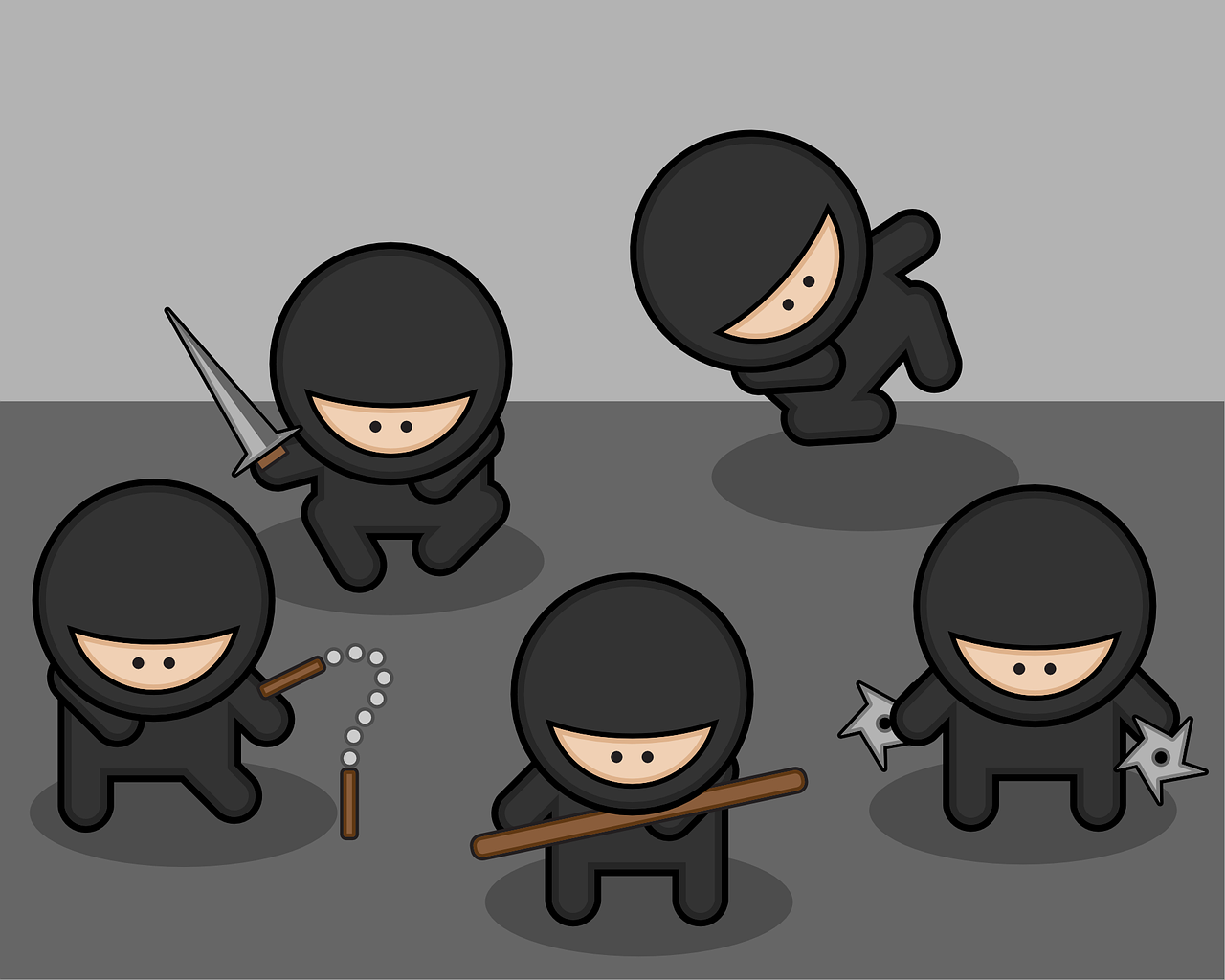
Cute… and very good at what they do.

Sometimes, you have to make do with what you have, no matter how “little” that is. It just might turn out it is not that “little” after all, once you get moving.

If you are like most people nowadays, that means you work a mostly desk-bound job, commute for a sizable chunk of your day, don’t get enough sleep, drink too much coffee and in general consume too much NOT FOOD items. Oh, and you have precious little time to exercise the way you know you should.

That’s why when I saw this image of five little ninjas, I was inspired to remind us all about the ways in which we can sneak exercise into our days without requiring big changes to our lifestyles. (As I wrote this post, I was also reminded of some ads for smoking replacement products that featured ninjas, so I can’t claim to be very original. But bear with me. My ninjas are cuter. And more healthy.)

So let’s call this the 5 Little Ninjas of Daily Exercise. (5LNDE for short in the rest of the text.)

Just like real ninjas (supposing such persons really exist), the 5LNDE are sneaky, which means that others might not even notice they are there.

The 5LNDE are also quiet; they don’t require big noisy equipment, or loud grunts on your part.

And because they are little ninjas, they might not appear deadly, but they certainly can make a difference if you do them often enough. Don’t be fooled.

So, without any further ado, here they are:

Walk Ninja – The very essence of stealth and quiet. Simply walking more on a daily basis will make a difference in your muscles and bones, and even though it does not burn many calories, it burns more than sitting and doing nothing in your car or in public transit. Go for a walk at lunch time, have a walking meeting. It does not require any extra time; just make it part of your daily getting from point A to point B. Let this little ninja sneak into your daily habits.

Stairs Ninja – Also very quiet, and can also be done as part of your normal movements during the day (instead of escalators/elevators, for instance). Or use a break or part of lunch time to sneak into the stairwell of your building, and go up and down for a while. 5 minutes. Very good for your muscles and bones, and burns a decent amount of calories, without making you sweat too much. Good ninja to have on your team.

Getting Up Ninja – To go talk to someone, or get water; any pretense is good to get up from your chair. Sitting is really, really bad for us. So the more often you can interrupt a sitting session, the better. Best still if you can work standing, but that is hard to pull off. The most effective, and sneaky, approach to this is simply to stand up once in a while. At least every hour, preferably more. The more active your day becomes, the better off you’ll be.

Squats Ninja – This may seem strange to witnesses, but when you have a moment, perhaps in conjunction with the previous little ninja, go down and then back up again from a standing position. Do 10 at a time at first. Slowly, while breathing. 20 is better. Full amplitude is better than partial; however, just doing the sitting to standing squat, and back down again, without using your arms to help yourself in and out of the chair, does the trick. It only takes a few minutes, so you can do it multiple times during the day. Easier if you have a closed office, but this little ninja can be active anywhere, without being overly conspicuous. And it does wonders for your legs.

Push-ups Ninja – Yes, I know, push-ups are hard. Harder than squats, and stairs. Perhaps even harder than running. But guess what? That’s precisely why they are so good. We systematically under-use our muscles, which means our bones have no reason to remain strong, and our base metabolism slows down because the muscles are smaller. Time to change that. You don’t need to do a whole lot; maybe 5 at a time to start. But do them a few times per day, and you’ll soon see results. Maybe not at the office, though I dare you to start a “lunch push-up club” and recruit a few co-workers to share the pain, er, I mean, fun. Do them first thing in the morning (it is very much like eating a frog), and in the evening. It takes almost no time, so it is the quickest of the ninjas. But just as effective.

That’s it. The 5LNDE.

Make them part of your team in the fight for better fitness and health.

Image from Pixabay

The only thing that matters

Movement, Exercise, Daily

It does not matter how fast.

Get moving again.

There. End of post. Shortest ever!

What, you don’t quite get it?

OK, I’ll elaborate a little. But just a little. (I still want this to be the shortest post ever from me.)

Take this post, for instance. It has been a while since I’ve written one. I’ve been busy, you know, with stuff: Selling a home, buying a new one, preparing two moves, planning a new life in a new town, doing a bit of money-earning work. Oh, and trying to get pregnant. (Not me: My wife. But apparently I have a contribution to make.)

It adds up. And whether it is the time it takes, or the mental energy it requires, it ends up leaving too little of either for me to muster what it takes to write.

And so you don’t get to read anything from me for a while.

It is just like when “Life gets in the way” and prevents us from exercising like we know we should. (Or must.)

First, you take a short breather, just to get over the urgent things. Then it gets a bit longer, because it always takes longer than expected. Then the habit appears broken, and it gets hard to find the time or muster the energy.

Next thing you know, you’ve not exercised in a while. Just like I’ve not written a post in a while.

So, what are we to do in such situations?

Get moving again.

That is the only thing that matters.

It does not have to be moving a lot. It does not have to be performing at our top level. It does not even have to be a good post.

Just get out there and move. Just find a bit of time.

You know why. You know it is the right thing to do. For yourself. For your Purpose.

So that’s it. Today, I’ve done my part (writing this post); now it’s your turn to do yours.

Get out there and move!

Picture by Sacha Veillette

P.S.: It is still pretty much my shortest post ever.

Use it, or lose it (a.k.a. Why bother exercise?)

Exercise, Aging, Everyday, Weight Control, Muscle Mass, Bone Density

Ready to take the plunge? If you don’t now, you may not be able to later.

Are you trying to exercise more? Or at all?

Has it been on your mind for a while? Perhaps you used to, but as the years passed, you went from “active” to “weekend warrior,” and ultimately to “I just don’t have the time.”

Perhaps you weren’t all that active as a youth, but as you went through your 20s and 30s you’ve noticed the loss of your effortless youthful figure.

No matter your story, you know you should be getting moving more. You feel it in your bones (quite literally, as it turns out).

You are not alone. And you are not alone in the struggle, either.

But have you stopped and really explored why it is so important to exercise, or to exercise more than you currently do? In that deceptively simple questioning might be hiding a profound source of Purpose

That is the question

Why is it important to you to exercise regularly?

Is it because you think it will make you look better (or a certain way)? To control your weight, perhaps?

Maybe it is to lose a few extra pounds accumulated over a few years of too much sitting behind a desk, in a car, and on a couch. Or all three, in turn.

Any of those may be a valid ultimate objective; they are certainly valued to varying degrees by different people. Yet they are not the reason why regular exercise is a good idea.

Leaving aside my own (admittedly strong) opinions on the goals and objectives of folks who exercise regularly, allow me to offer a simple and compelling reason why you must exercise regularly. As background to what you are about to read, you might want to look back at the principles behind training.)

The answer

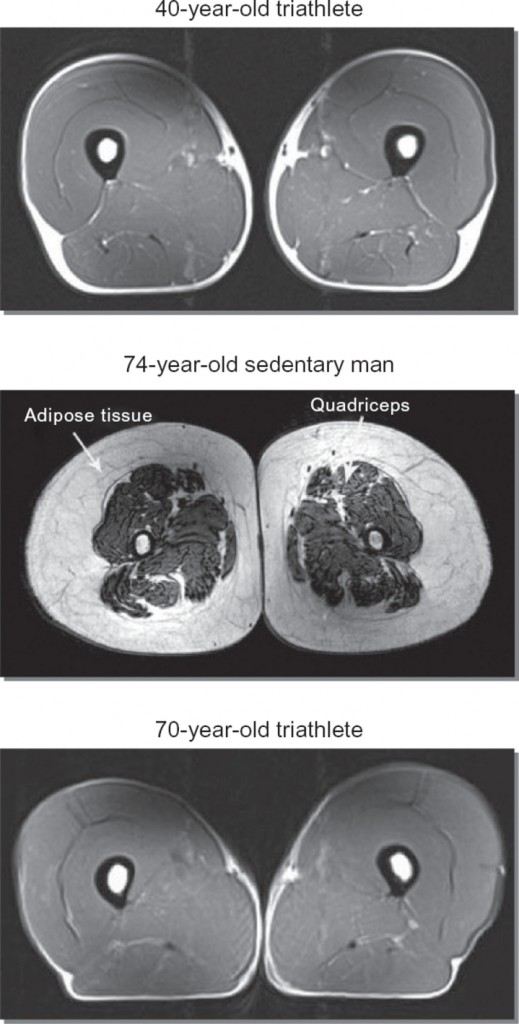
The answer is simple: If you don’t exercise regularly, you’ll lose important muscle mass and bone density.

Muscles, Athletes, MRI, Ageing, Muscle Mass, Bone Density

Which one do you want to be when you grow old?

You see, if you don’t exercise, your body, being the result of hundreds of millions of years of evolution, does the most logical thing and stops investing in expensive to build, and costly to maintain, muscle mass.

In turn, when muscle mass decreases, strain on bones also decreases: Basically, if you don’t move much, your bones don’t need to be strong. So once again your body does the evolutionary logical thing and divests itself of bone density, which is expensive to maintain from a biological standpoint.

That’s how the body works: If you don’t use it, you lose it.

And that’s the real answer. Anything else is confusing the main cause (muscle mass and bone density loss) with its consequences, or symptoms.

The consequences (or symptoms)

Yeah, sure, you may gain weight of the fatty kind if you don’t exercise. Exercise burns calories, so it helps keep the weight off in the long run, or maintain a healthy weight. If you keep eating like you did when you were 20.

But keep in mind that when you start exercising, you will gain some weight of the non-fatty kind, so at first your weight may go up, not down. Or stay the same if you never really let yourself go.

Also, the main reason you gain weight, which is the symptom, is that without enough muscle mass, your base metabolism is greatly reduced. So if you keep eating the same quantity, or, worse, you eat more as you age, you will put on the pounds. However, this is not what happens to everyone.

Another, less talked about consequence of “losing it,” is an increased risk of injury from not having sufficient muscle tone and bone density when attempting certain actions or movements. We are accustomed to think of this as the “natural” frailty that elderly folks have as they age, but it is already showing up at younger ages, especially for those who forget that they are no longer 20…

And there is nothing natural about becoming frail as we age. That frailty is the direct consequence of losing muscle mass and bone density. Of not using our bodies enough.

There is also mounting evidence that our internal organs, and our brains as well, don’t function optimally when our bodies are not moving enough. Though that is a little beyond the scope of this post, the principle of “use it (your body), or lose it (your mind)” also applies.

All good things must come to an end

Our bodies are marvelous biological machines. But they are not magical; they obey very specific rules that make sense from an evolutionary, biological standpoint. And they get older, of course.

Magical thinking about being able to be healthy in the long run without exercising regularly, or just by controlling what we eat, won’t make it so.

It is a fact that we all age and that some day we’ll die. It is a fact that many of us are getting heavier and rounder due to fatty deposits over time. And it is also a fact that many become frail as they age.

But it does not have to be so. Although there is no absolute guarantee of health into old age, because much can happen, the way to improve the odds is well known.

The key is to move more, everyday, so as to maintain the all-important muscle mass and bone density you’ll need to age gracefully into your 30s, 40s, 50s, 60s, and well beyond if you keep at it.

And here’s a further thought in closing: Since you want to have all those years ahead of you, consider picking up a new sport now that you’ll be able to practice when you retire. After all, you’ll have a lot of time on your hand then; might as well fill it with something fun to do.