First things first: put your muscles on


Dancing, Music, Muscles Mass, Aging

Put on some music, but put on some muscles, too.

What does a little old lady on Britain’s Got Talent, an article claiming that muscle mass is a better predictor of longevity than BMI, and No-brainer Fitness: E, have in common?

Other than being tidbits of “information” you can find on the Internet?

Well, the first may very well be an illustration of the second. Anecdotal, to be sure, but an illustration nevertheless. And the third is definitely derived from the principle of building muscle mass as a starting point to having fit and healthy bodies well into older age.

First, the little old lady.

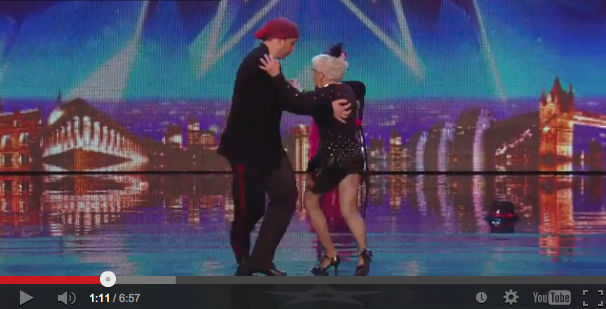
Paddy is 80 years old. And she’s on the show with a much younger, much taller partner called Nico. They are doing a dance routine. At first, it’s tame and boring. And then, her partner starts twirling her about, lifting her and spinning her in the air. Acrobatic Rock ‘n Roll style. The audience holds its breath, commentators are speechless.

Why? Because everyone is afraid for this fragile little old lady. She might break a hip. She might lack strength and let go as she’s dangling precariously, and then crash and need an ambulance. You can see them thinking it. Heck, it’s almost impossible not to think it.

But she doesn’t. She holds on, and finishes the routine on her own high-heeled two legs. With a smile.

Why would we think this extraordinary?

Because we have been trained, perhaps brainwashed, into thinking that becoming old means becoming fragile. That frailty is the norm for older people.

But as MRI images of older triathletes reveal, in comparison to both younger and same age but sedentary folks, when you maintain your muscle mass and remain active, other than slowing down some and requiring more recovery time, we can remain lean, muscular, and prevent our bones from losing strength well into old age.

Second, what about that article about muscle mass?
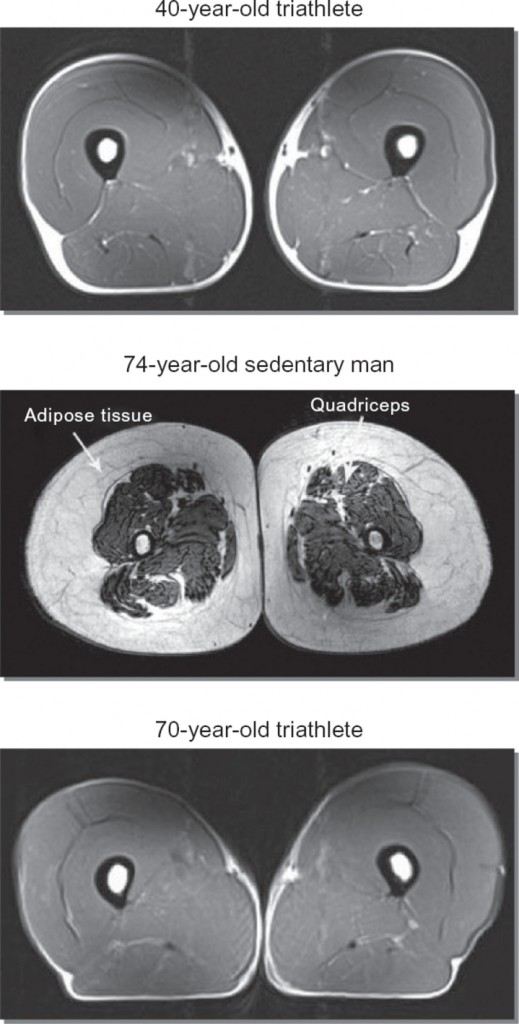
Muscles, Athletes, MRI

Which one do you want to be when you grow old?

While most of the medical establishment (and people providing dietary advice) have been saying for some time that losing weight is good for your health in the long term, it seems in fact that having more muscle mass, even with a higher BMI, is a better predictor of outcomes.

Simply put: Don’t just try to lose weight; put on some muscles. It’s better for you.

I’m no expert, but I can think of many reasons why that would be logical, beyond the fact that diet alone never works:

  1. Muscle mass is what burns the most calories; so the more muscle mass you have, the higher your base metabolism, and therefore the less you tend to gain weight. Or the faster you burn through extra reserves. Remember that excess weight, especially abdominal fat deposits, is a major risk factor; but muscles burn calories, so you don’t need to starve yourself half to death to lose the weight.
  2. Muscles are what put strain on your bones, and therefore keep them from becoming weak (in reaction to the strain, bones become denser, and more sturdy). Stronger bones means less chances of fractures, which is an important contributor to loss of autonomy and health in older age.
  3. A stronger body in general is insurance against injuries caused by attempting to perform tasks that once were normal, but that become a challenge as we age. We’re not old in our heads, so when we think we can do something, but have not maintained our bodies, we run the risk of getting hurt.

The main issue, as I see it, is that as we age (starting around our mid-twenties), our metabolism and hormonal equilibrium shift, and it takes some activity to maintain muscle mass. It is not automatic that we gain weight, but if we lose muscle mass because we don’t use it enough, then we start to burn less, and thus put on the weight.

A good remedy to that is to maintain muscle mass. Or re-build it.

This is where No-brainer Fitness: E comes in, as a third part to the initial comparison.

The first thing to focus on when beginning a new regimen of activity is re-building muscle mass. And that is precisely what occupies a great deal of the time of No-brainer Fitness: E.

The best way to protect your body against excess weight and injuries is to have a stronger body.

And now, it seems, research is showing that long-term health is better if you have greater muscle mass.

So put first things first, and re-build (or maintain) that muscle mass. (Which is not the same as saying that you should not do any cardio, or eat badly. It’s just a place to start…)

References:

Muscle mass index as a predictor of longevity in Older adults, The American Journal of Medicine (article in press), 2014

The article from which the MRI images are claimed to originate can be found here.

Watch Paddy and Nico here. (Hopefully that link is still up…)
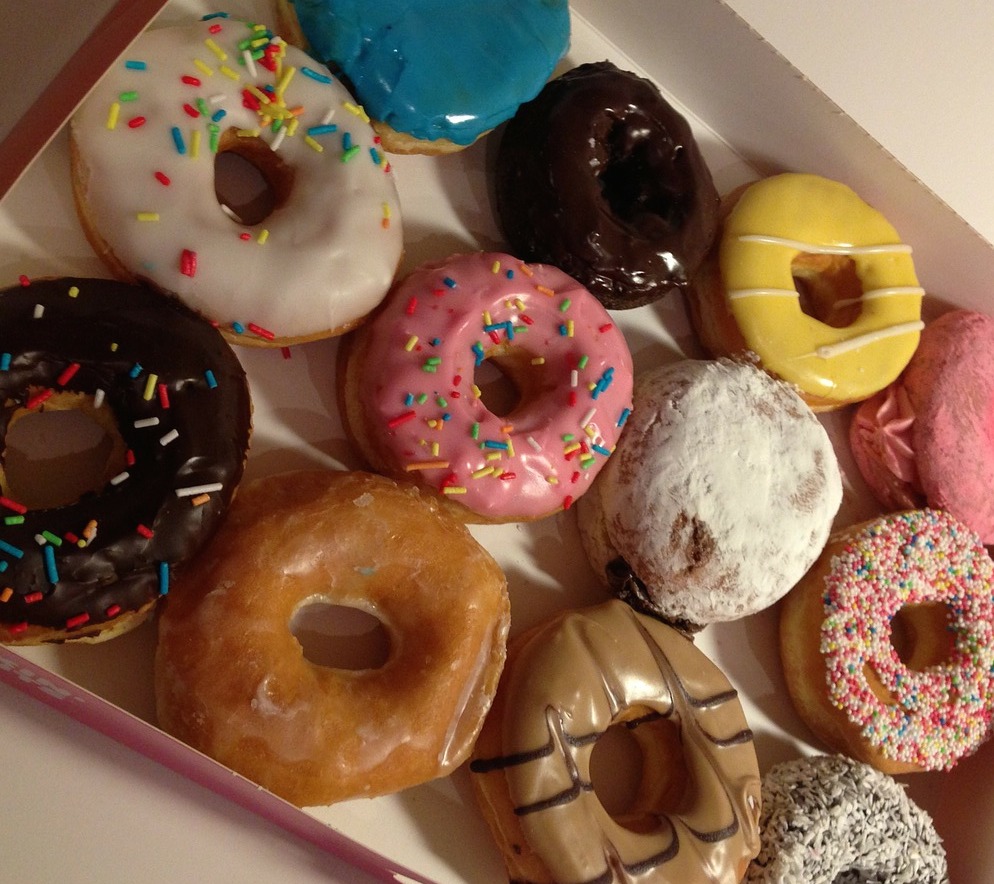
Just say “NOT FOOD” to these items

NOT FOOD

That’s a nice gesture… or is it?

It seems everybody is blaming sugar nowadays for our BMI and metabolic woes.

It is hardly news anymore, but it bears repeating: Added sugar, of any kind, is a bad idea.

The presence of a lot of added sugar, or things made purely of sugar, are prime indicator of NOT FOOD.

While the case of pops (so called “soft drinks” and carbonated drink products that contain little more than sugar) is open and shut as being NOT FOOD, there are many other items we ingest unthinkingly that deserve that mention as well.

At the risk of upsetting many, here are a few that you should stay away from, or at least be conscious that they are firmly in that category as well.

Doughnuts (Donuts) – This is a case of “the hole will make you bigger than the parts”. The only nutritional value you might be able to get from doughnuts is the fat. Then again, what kind of fat is used in industrial manufacturing of those things? Doughnuts are more aptly named donuts (“do nuts”) when surreptitiously brought to the office by a well-meaning (?) co-worker, and left for all to “enjoy”. The sugar boost you get (and the subsequent crash from the insulin spike) you get is sure to make you combative in meetings, and then very much unproductive when you need to be. Just say “thank you, but NOT FOOD for me” next time…

Muffins – Yeah, I know, there’s your full bran muffin, and your “healthy cranberry”, and your “heart smart low fat” stuff, but, really, this is just another calorie bomb loaded with easily digested carbs, fats, and loads of sugar. All too often automatically picked up as a breakfast substitute (though many omit the word substitute, that is really what it is), it is certain to give you a short-term boost along with your coffee. But it will be short-lived, and you’ll crash. Next time you meet one in a coffee shop, say “my fun, muffin, won’t be with NOT FOOD today”…

Cotton Candy – Ok, so you don’t run into this all that often, but in case you do, keep in mind that it is spun sugar, pure and simple. Well, not that pure, and perhaps not that simple, what with the coloring and such. I just felt like putting this one on the list today. So there: Next time you go to a County Fair, or circus, or any such event and are tempted to buy some, keep this in mind. Though a funny coloured tongue is always good for a laugh.

Chips – Well, if you thought this list is about sugar only, you were wrong. NOT FOOD comes under many guises. Never mind that potatoes have been selected over millennia for their starch content (complex carbohydrates, or long chains of sugars), unless you chop up a real potato yourself and bake it in an oven, what you get from chips is, well, anyone’s guess. Especially my favourite, which are so uniform in shape that there can be no doubt they are fabricated that way. And there’s the rub: When’s the last time you saw a tree in which bags of chips grow? Huh? With chips, you get fast carbs (too fast), loads of salt (too much), and so many additives (not necessary). Potatoes in a normal diet is not the worst thing you can do, but chips are definitely NOT FOOD.

That’s quite enough for one day. Especially right after lunch…

The idea is not that you must stop immediately eating such “things”; however, you should develop a perspective on their status as NOT FOOD, and be more mindful when they are proposed to you. Or you order some food and “just take the trio” (which usually consists of chips and a pop!).

Simply accepting the “donated” donuts, or grabbing a muffin with your coffee, or impulse-purchasing chips when you are grocery shopping in a hungry state are the behaviours you need to stop. And to do that, think “NOT FOOD” when you see those items. And move on. You can do much better with real, natural food.

Your taste buds, and the rest of your body, will thank you for it.


Photo from Pixabay.

From the Library of No-brainer Fitness

Books, Exercise, Diet, Willpower, Happiness, Paleo

So many books, so little time…

A really short post, for a change. You probably did not think it possible coming from me, yet here it is.

Here are books I’ve recently read, or am currently reading, and that I highly recommend. Perfect for a rainy Sunday afternoon…

The Paleo Diet for Athletes: The ancient nutritional formula for peak athletic performance. By Loren Cordain, Ph.D., and Joe Friel, M.S. Not exactly a day-to-day guide to nutrition since I don’t subscribe to everything that is “paleo”, but certainly an inspiration for reducing carbs and eliminating processed foods and NOT FOOD (a work in progress). I particularly like the pragmatic approach to eating paleo when doing endurance sports, which is of course not a strict paleo diet.

The Willpower Instinct: How self-control works, why it matters, and what you can do to get more of it. By Kelly McGonigal, Ph.D. This book is structured like the lecture series she gives at Stanford University, and contains exercises to be done week after week, so it takes a while to get through it in order to really benefit from the material. But it is worth the effort. One of the key elements for having more willpower is to be fit (exercise, sleep well, etc.), and of course some willpower is useful to keep us moving everyday. So it is a positive feedback loop.

Spark: The revolutionary new science of exercise and the brain. By John J. Ratey, MD. I just started this, after first encountering him in a FranklinCovey lecture and then listening to his TED talk, so too early to give a review, but very promising.

Eating on the Wild Side: The missing link to optimum health. By Jo Robinson. This is from an investigative journalist in the field of food (agriculture, nutrition, “field”, get it?). What’s really interesting is the discussion about changes some 10,000 years of human selection and hybridization of plants have made to what we put in our digestive systems. Basically, a truly paleo diet is impossible nowadays, because the food that existed then no longer exists. Case closed. A quick read, and quite enlightening, and many interesting tips that can be consumed over time.

The Happiness Advantage: The seven principles of positive psychology that fuel success and performance at work. By Shawn Achor. A bit of a personal thing, but highlighting how important it is to have a balanced life, to exercise, eat, and sleep well. Let’s face it: it is all inter-related.

All of the above are easy to find in either paper or electronic versions.

Next on my list is to read Dr. David L. Katz’s book on nutrition and health; once I’ve done that, I’ll likely spend much more time talking about it.

Good reading!

Photo from Pixabay.

In Praise of Coffee

NOT FOOD, Diet, Everyday

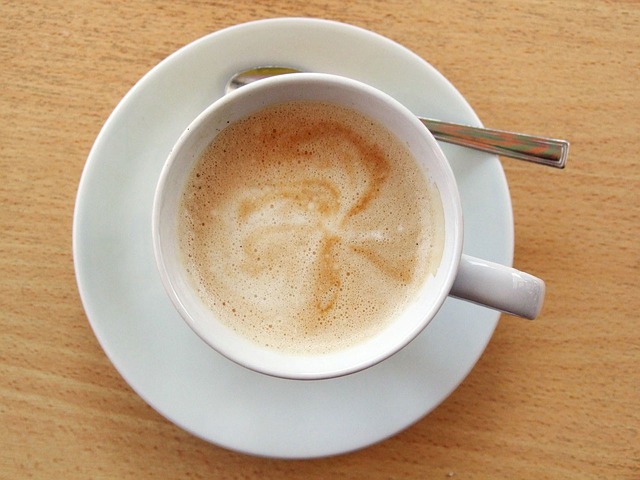
Coffee, can’t live without, or can we?

This post could also be called “Almost an Apology for Including Coffee in the List of NOT FOOD”.

A recent post, by which I fully stand, brought me some comments from people very close to me. (Ok, my wife and I had a conversation about it.)

You see, we both love coffee. As I’m sure many of you do.

Yet I went and put coffee on the list of NOT FOOD! Sacrilege!

Well, not quite.

Let’s be honest with ourselves: Coffee is NOT FOOD; it is a drug, albeit a mild one, but a drug nevertheless.

Most of us consume said drug not because we particularly enjoy the taste, but because we believe we need it for going about our daily activities. Or simply as a habit. Much of the blame for that falls squarely on our tendency to get too little sleep (more on sleep hygiene in a later post) and some on “just doing like everyone else”.

It is my contention that given a good regimen of everyday exercise, good sleep, and proper diet, the industry that has been built around coffee would collapse.

Or maybe not. Some people really like coffee. I’m one of those. The bitterer the better. So I drink my espresso black, and I have 2-3 short ones per day, or a short one and an “allongé”.  Almost always before noon.

And I can go days without having any. In fact, I was completely off coffee for many years, at one point in my life. (No, I don’t mean when I was a child, about which I have a funny story, for some other time.)

Coffee is likely here to stay. And that’s OK. As long as we are clear that it is NOT FOOD.

Therefore, when drinking your coffee, beware of the following:

  • It should not be a reflex action. Make it a conscious decision, and be fully aware of what that choice means. For instance, if you don’t like it black, be aware of how much sugar and/or milk/cream/other stuff is in there. Your coffee can all too rapidly become a calorie bomb, and in so doing negate any hoped-for gain in wakefulness by causing an insulin peak and an energy drop later. Then you get trapped in “needing” another coffee to “help” when in fact it is causing more harm. Not to mention the long-term effect of so many calories on your body.
  • A coffee should not automatically be accompanied of something sweet. Forget the doughnut (donut), cookie, chocolate, or whatever you may absent-mindedly just consume with your coffee. Not only is that likely also NOT FOOD, but it probably packs a punch of calories you don’t really need.
  • Coffee should definitely not be consumed regularly in the evening, or even afternoon. While many claim that it has no incidence on their ability to fall asleep, it may have a negative effect on the quality of that sleep. From sleeping badly, to waking up and not being able to fall back asleep. Then, having not slept enough during the night, the cycle of drinking coffee resumes in earnest in the morning.

But it is not all doom and gloom: You are probably not among those I describe in this post. I’m sure you manage your coffee intake well, and that you are aware that it is NOT FOOD. That’s key: knowing this, you can deal with it, and consciously decide to have some, once in a while. Or regularly. But on your terms.

Just in case, try this little trick: When you see a coffee, impose on the image a label that says “NOT FOOD”. That should trigger the correct reaction in your mind.

Then enjoy some, black, no sweets on the side. Or perhaps not black, and some sugar to “kill” the bitterness, but then only a small coffee, and something truly nutritious to dampen the sugar rush.

I know I will.

Photo from Pixabay.

NOT FOOD: A User’s Guide

NOT FOOD

That’s a nice gesture… or is it?

If you’ve read some of my previous posts, you’ve seen me use the expression “NOT FOOD.”

Today I’ve decided to expound a bit upon that notion which, as far as I’m aware, I’m the only one to use. (There might be good reasons for that, like it not being a good expression, but bear with me for at least this post. Thank you.)

To begin, you might be wondering what are NOT FOOD.

Simply put, it is any “thing” that we drink or eat but that, technically speaking, is not providing nutritional value. When we have a decent diet, eat what our bodies really need, such items don’t figure in the list. We could live our entire lives without NOT FOOD, and be none the worse.

Moreover, if you were to look for them in nature, these items could not be found, certainly not the way we consume them. Therefore they are typically highly processed forms of things that may be natural, but that you could not obtain without that processing.

I extend that definition to also point out that NOT FOOD are often items that, when consumed, have no biogenic quality. They are neither necessary for, nor positive contributors to, the functioning of our bodies. In fact, quite often they are, or may be, dangerous. Particularly in large quantities.

Finally, a hint that something may be NOT FOOD can be found in the advertizing of such items: If some people go out of their way to point out what’s good about an item, chances are it is a stretch.

Here are the main examples:

  • Pop, whether normal or diet, or whatever. Sodas don’t grow in nature, and we are not hummingbirds or insects able to live on sugary liquids.
  • Chewing Gum. I should not even need to talk about this. Totally useless. And so elegant to watch…
  • Candy, sweets in so many forms. Mostly sugar, practically addictive. To my chagrin, this includes chocolate…
  • Alcoholic beverages; see the comment about dangerous in the definition. Alcohol is a poison; consider the wine lobby’s effort to convince us that trace micronutrients in red wine are good for us. ‘nuf said.
  • Drugs of all sorts that are put in our bodies, not necessarily through the mouth. Seriously, do I need to spell this one out?
  • Coffee, tea, hot chocolates, etc. Sadly, these are also either drugs, or processed forms of items we could not consume without the processing. Although an important part of our daily habits, we do not need these items to live.
  • Supplements of all sorts, especially those that come with extraordinary claims attached. To believe their publicity, none of us would be here because our ancestors certainly never had such things in their diet, and therefore how did they ever survive?

Makes sense? Now, what can we do with NOT FOOD?

Well, one thing that comes to mind is “Arts & Crafts.” Let’s face it, if the stuff is not needed inside our bodies, why not make pretty decorations with them? Lampshades, collages, etc.

Ok, seriously now. Other than the simple fact that they don’t contribute to our dietary needs, and that they can even be bad for our health, we should not eat or otherwise put into our bodies any NOT FOOD items.

But we like coffee, and chocolate, and tea, and the occasional sweet. Not to mention celebratory libations from time to time. I know: I’m right there with you.

So what are we to do?

First, become aware that those items are NOT FOOD, with all that it implies.

Second, if you make the decision to consume NOT FOOD items, do so in a conscious manner, not as an automatic behavior.

Third, never, EVER, think that NOT FOOD items can replace proper diet, or are part of it. If you consume some NOT FOOD, consider the additional burden you thus place on your body, and that proper nutrition is still needed.

Therefore, do so in moderation, and consider that it is an exception, not behavior as usual. Except for the stuff that’s truly, completely useless, like chewing gum. That’s just ugly.

Now, where did I put that chocolate bar?

NOT FOOD

Arts & Crafts, the only logical use for NOT FOOD…

Photos from Pixabay.