What makes a good coach? Part 1

Coaching, Team, Sports

Coaching, at its most influential.

I could go on for hours on the topic of coaching, and over time I will. At the very least, I hope it will be interesting. So I’ve planned a series of posts on the topic.

For starters, I’d like to share a bit of a story: Mine. (Yeah, I know, boooring. Bear with me, it has some insights you might find valuable.)

This is the story of how I got started as an “athlete”. Or, more to the point, how I became an athlete without really realizing it.

And it’s all because of a coach.

Beginnings

As a young child, I did like most of the kids in my neck of the Canadian woods: I played hockey. Although I was reasonably good, especially as a goalie, I only lasted 2 seasons.

Somehow, at 5-6 years of age, I had to endure the politics of sports managed by grown-ups. So, no, the story does not feature that coach.

In retrospect, hockey wasn’t my thing, even though I continued to play for fun, on ice and on snow-covered streets, throughout my childhood. But officially, I retired from hockey at 6, and spent the next few years mostly reading books.

Until the end of grade 9, I was considered pretty much hopeless as far as sports went. Last to be picked at dodge ball, unable to swim to save my life, not able to score hoops at mini-basketball, no running endurance, etc. You know the type.

New Beginnings

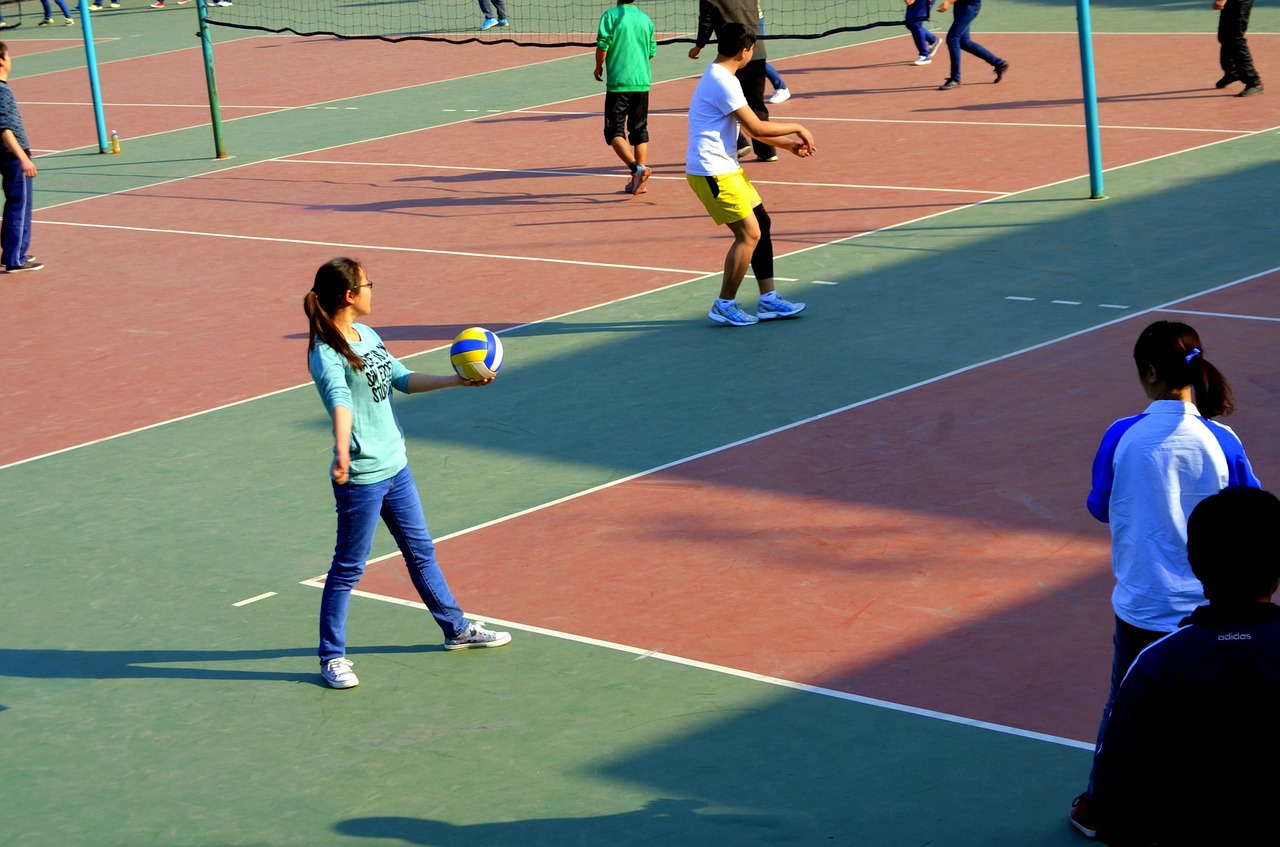
All of that changed at the end of grade 9, when I showed up at a volleyball camp.
Coaching, Training, Sports, Volleyball

Beginnings are key. But there can be many beginnings…

You see, volleyball season was over, but the coach was setting up this camp in order to get kids interested for the next season. Through games and challenges, he got us to build some basic skills as well as have quite a bit of fun.

One thing you need to understand already about this coach is that he cared about the long-term development of his teams, and the athletes thereof.

I recall that it was pretty difficult. But the challenges were achievable. And then you’d move on to the next level.

It was enough fun that when the next school semester started in September of my grade 10, I signed-up for volleyball. Me, almost the least athletic nerd around.

At volleyball practice, however, it was all about rising to the challenges put before us by the coach. And having fun. Very progressively, he developed us into volleyball players. He knew what he was doing; so much so, in fact, that we didn’t have to do any more than show up at practice and do what he told us to do.

In relatively short order, without really noticing it, I became one of the best players from a technical standpoint. I could not do much about my height, but I also compensated reasonable well by being fast and jumping higher than almost everyone else. And everyone around me was progressing, too. Some faster than others; yet everyone was gaining skills and fitness.

Learning

If you are paying attention, you now also know that this coach was tailoring the training to the skill levels of his athletes, and making sure they could progress according to their own abilities. We, the would-be athletes, did not have to do any extra training, or even think about it: all we had to do was show up and do as we were told.

Our coach did not need to motivate us to learn, or to show up for practice. We wanted to. Because he made it fun to be there, fun to learn.

We had reasonable success in the local league that year, even though our large pool of players was split into two evenly matched teams, so that the entire league could have a full complement of 5 teams.

When the next season came along, we moved on to the inter-city league. Now we were “big boys”, in grade 11, playing against guys that were older and much stronger (at first) than us.

But it did not last.

Through more playful challenges and gradual development of play tactics, for which by now we were getting ready, I moved from “the small guy on the team” to starting setter, challenging and, by mid-season, beating, the other setter who was a year older than me.

The team, that year, went on to finish second in the inter-city league, and win the regional civil championship to earn a spot for the provincial championship.

How did we do it?

Performing

Our coach adapted tactics to the team we had; the unique blend of athletes we were, and the situations we were in. He had the right encouragement at the right time. He pushed us when it was time (we started serious physical conditioning only that year, for instance), and told us to let go when it wasn’t time to push.

When he was upset, we paid attention. When he was pleased, he was able to make us all feel good.

He was a friend, and a bit of cheerleader at times, but not all that often. For the most part, he knew his stuff, and he was extremely well prepared to guide us through planned training sessions that had both physical and technical development goals.

No idle play, ever. No wasted time. Every drill had a purpose. Even the 4 on 4, 3 on 3, 2 on 2, and 1 on 1 games we played were challenges to build personal skills and team cohesion. And by then it was fun to challenge each-other that way.

Are you getting the picture I’m trying to paint?

Coaching, Team, Volleyball, Training

To reach high levels of performance, a coach is the way to go.

Coaching

As a side-story, by the beginning of grade 11 our coach had asked for help from us “athletes” to develop younger kids for future seasons. Some of us helped out, first by using or copying training sessions our coach would prepare, and later by applying the same principles and directing our sessions ourselves. That’s how I learned how to build a training session: by absorbing it, not by reading about it.

He encouraged us to learn as much as possible, but did not push. Not everybody got involved.

By the time I turned 16 and moved on to grade 12, my last year of high school, I was a certified coach and I had the responsibility of two local teams (about 20 kids, some barely two years younger than me). Oh, and I was the star setter of my admittedly small region.

Many of us from that team, built by that coach, went on to play varsity at the college and university levels. Some of the athletes I coached also did, but that’s more because they were later on coached by “my” coach as well…

We never found a better coach, no matter how far or “high” we went in our sporting careers.

Since that time coaching has been second-nature to me. You could say I learned well; I think I had an amazing example to follow.

And it’s been hard for other coaches to live up to that. But that’s an entirely other story.

One thing is certain: Learning to be a coach and coaching “the right way” has helped me through school (whether I tutored friends, or as a TA in grad school) as well as professionally (when it was time to train partners and resellers on new features, speak publicly, or simply give a presentation to colleagues). By witnessing, later on analyzing, and ultimately integrating how my coach was doing it, I was able to do the same in various settings.

The End (of the Beginning)

And that was the story. Next time, the lessons.

Pictures from Pixabay

Not all advice is good advice

Coaching, Training, Swimming

Online advice as replacement for a real coach? Photo credits: Sophie Tremblay-Paquet

Should you really trust the advice you read online? Should you seek such advice, instead of turning to a coach?

(What follows is a spoof, NOT meant to be taken as real advice. Anyone tempted to do so would only prove my point, but I’m sincerely hoping everyone has more sense than that. Enjoy at your own risk…)

Take your triathlon racing to the next level

Wanna take your triathlon racing to the next level? Wanna win races in your age group? Perhaps you still have this nagging feeling you could have been a pro?

Here’s how to get one step closer to that dream, and take your racing to the next level. You’ll be amazed how simple it is:

Have all your teeth removed and replaced by dentures.

Your training and racing will benefit in many ways from this little change in your body configuration:

1) While you recover from the surgery, the mostly liquid diet combined to extensive endurance sessions will cause you to lose a lot of weight, improving simultaneously your power to weight ratio and VO2 max.

2) Since in the beginning you’ll have a hard time eating anything, this is the best time to do a lot of training on an empty stomach, thereby improving your body’s ability to use lipids from fat reserves as fuel.

3) After you’ve recovered and been fitted with dentures, every time you’ll be racing, you can leave your dentures in transition (or at home), and be at an even better racing weight than the rest of the field thanks to the reduced weight to carry around. (And since you are also fueling your race mostly with gels, you don’t really need your teeth anyway.)

Be the first in your age group to do this. You won’t regret it! Besides, if you can still smile on your finisher’s photos, you’ve clearly not pushed hard enough…

(End of spoof.)

Back to our regular program

As a coach, I’m amazed at how much advice you can obtain by simply going online and performing a cursory search.

It is to the point that one hardly ever needs to turn to professional coaches for advice. Or buy well-written, well-considered books on how to train.

Or is it?

The Web is indeed shock-full of running, swimming, and triathlon advice (not to mention other sports, but those three appear to be popular nowadays). However, is it always good advice? More importantly, can such random bits of (generally good) advice really be the best course of action for athletes hoping to develop in their sports?

My main concern, because I am a coach, is with what coaches do: provide the best guidance possible at every stage of an athlete’s development. My contention is that advice sought on the Web, or pushed in our faces on social media, is NOT, in fact, the best advice. It may not even be good advice.

Why?

Because it does not consider where in his or her development an athlete might be.

It is advice out of sequence; out of the flow of development of abilities, endurance, and speed.

Some of the advice, I’m afraid, even goes against optimal health, generally in the name of enhancing performance. (I’m really talking about triathlon advice here, not other kind of performance enhancing advice or products.)

I’m preparing a few posts on coaching, and I will address this concern at length, but to set the stage, I thought I’d offer this short spoof of some triathlon advice I recently came across.

And I’d like to hear from you about your impressions of the advice you get online. Do you seek it? Do you follow it? Do you use the services of a coach?

More to come on this topic… and looking forward to hearing from you.

Photo by Sophie Tremblay-Paquet.

The correct way to run

Running, Technique, Shoes

Shoes matter, but so does technique…

*** Modified post. I’ve been able to get a hold of the original paper about transitioning to Vibram FiveFingers. So read on, or read again, for some slight changes to the text. ***

There’s been noise lately about a settlement that Vibram, the maker of the famous (or infamous, according to some) FiveFingers “shoes”, has agreed to pay to their customers.

The issue is over false claims, or so the class action lawsuit alleged, that FiveFingers prevent injuries and make muscles and tendons stronger.

A quick search on the subject will surely reveal quite a bit, but I’ve sprinkled a few links in this post, to provide more details. First, the oldest reference to the lawsuit I could find, from July 2012.

Blog item from ABC

The most recent article, in a Canadian magazine, appears to provide the conclusion of the process. Note that Vibram has agreed to pay; I’m no lawyer (I’m a scientist), so I would be willing to bet that the issue revolves around what would constitute a solid enough proof of the statements made by Vibram. I’m pretty sure no scientist would be willing to proclaim the statements are proven beyond a doubt. That’s just the way science works…

Blog in Canadian Running

But what fascinates me about this is the tone of some of the articles. Some “reporters” and bloggers clearly showed their stripes and did not hesitate to bash Vibram, minimalist shoes, and the whole barefoot running movement. It felt like a deep, quasi-religious, fighting line has been drawn. I won’t bother you with those articles; the ones in reputable running magazines were far more neutral, and carefully written, as they should be.

Some, however, did something very clumsy, unlike the main magazines: They linked the lawsuit to a piece of research pertaining to indicate that wearing FiveFingers leads a high percentage of runners to foot bone injuries. You can read the news about the report there:

Report on study in Runner’s World

Note that the study, and the lawsuit, are in no way related. But it sure is convenient as a coincidence. Especially for the makers of conventional running shoes.

Before going any further, allow me to state a few key points, just to be clear:

  1. In my experience as runner and coach, it is possible to run correctly in almost any pair of shoes, be they “conventional running shoes” or “minimalist”.
  2. I do not believe there is a conspiracy by running shoe manufacturers to cause harm to runners by making shoes that they know will cause injury. Even though by some accounts 70% of runners using “conventional running shoes” will get hurt at some point.
  3. What I do believe is this: there is a natural tendency to want to protect your business and market share. That’s called having a vested interest in a certain situation. There is no need for any kind of conspiracy when the incentives are aligned. Companies will do what is in their best interest.
  4. There is a correct way of running, and it is easily demonstrated. No matter what anyone in the running shoe industry says about each of us being different. They only try to muddle the issues, and it is very sad.
  5. What has probably happened with the minimalist and barefoot movement is not an indication that the safety and benefits of those shoes have been overstated, but rather that the weakening of our bones, muscles, and tendons over the years of walking, and especially running, in shoes designed to “protect us”, has been grossly under-estimated.

Now, perhaps the lawsuit was brought about by someone “strongly encouraged” to do so by the big shoe manufacturers. And maybe the study referred to in Runner’s World was also similarly sponsored. (There are some issues about that research, so please see at the end of this post for my notes. But the main problem I’ve encountered is that the second-hand source all seem bent on using it to point nasty fingers towards Vibram and minimalist and barefoot running, whereas the research paper was pretty much simply stating that transitioning must be done slowly, and carefully.)

But, ultimately who cares? The lawsuit was settled, so let’s move on. Preferably, by continuing to run.

Full disclosure: I currently own 3 pairs of FiveFingers, and a fourth one I used to own recently “died” after a long and satisfying life. Like some of the commentators on the blog posts and articles I’ve read, if I get a refund from Vibram, I will use the money to get an extra pair of FiveFingers, and I’ll keep using them for running. I even got married in a pair of FiveFingers. I hesitate to call them shoes as to me they are more like gloves for feet. I also own Ecco’s Biom Project shoes, and Asics runners (2 pairs), which I still use at times, when running marathons and ultras, and when racing triathlons. So there.

Now allow me to finish with the main point, before I forget: The correct way to run.

It is my contention that there is such a correct way, as already stated, and that it can be done in any pair of shoes. How do I know?

Not from understanding physics (which I do) and its application to bio-mechanics, or coaching a lot of runners (which I have), or transitioning myself late in life from a heel striker to a forefoot runner (which I have, over a period of 2 years). The answer is actually much easier to understand.

Consider the animals that we are. Remove us from this modern society we’ve built, and in which, by and large, we are no longer fit in an evolutionary sense. Let’s travel to the Land Before Shoes. How did we run then? Not on our heels, that’s for sure!

Test it for yourself. Take your shoes off, and try to run, even if for just a few steps.

You’ll immediately, instinctively, switch to a forefoot striking gait, and that striking will be absorbed in large part by the arches and ankles of your feet, and the tendons and muscles of your legs. Because that’s what they have evolved to do! (Normally, I urge people to do this test on soft grass, but it is possible to heel strike on very soft ground, so be cautious, and do it on a hard but clean surface, for full effect.)

Watch young children run barefoot. You’ll immediately notice that when not taught otherwise, we all run with a forefoot striking gait.

That is the correct way to run.

It’s just that over years of under-use, over-protection, we have not developed the needed sturdiness to run that way as adults.

It takes time, much more than a few weeks, to compensate. And it can be painful. And you risk injury if you try to do too much, too soon. So it should probably only be attempted with the help of a good coach.

Yet the conclusion is inescapable: There is a correct way of running.

It just may not be the way everyone can run in this day and age. For having run too long in conventional shoes, or lacking the patience to rebuild their bodies…

Running, Shoes, Technique, Coaching

In case of doubt, wear shoes, and make a run for it!

Photos by Sacha Veillette.

Notes on the original research paper by Sarah T. Ridge et al.

For those interested, and because I am a scientist first and foremost…

In terms of methodology, the design of the research was sound, as far as it went. However, I have concerns over the following items, some of which may invalidate the conclusions:

  1. While selection of FiveFingers users was random (among each group of men and women, so that’s good), all runners were experienced runners. Which means they were all used to running in conventional shoes, and had not been injured (or said so) in recent past. So far, so good. Except for a bit of psychology of running: Although the runners were given instructions on how to transition, most runners who are used to running a certain distance per week have a tendency to think they know what they are doing. In a word: they feel they can do it, no matter what. The odds of the FiveFingers group actually having followed the transition plan are slim, in my estimation. And my estimation is supported by the reported fact that FiveFingers users peaked their training volume in week 4 of the study, way too early! Simply put: they probably tried to run more with the FiveFingers than they should have, got hurt, then scaled it back down, but it was too late.
  2. Regarding the MRI results, which I’m told were taken with a somewhat low quality machine, the convention of what constitutes remodeling of the bones and injury is arbitrary. And perhaps a bit conservative. Being slightly less conservative, by only one level on the scale used, might change the conclusion. Interesting fact also reported in the article: the results are comparable to having sedentary people start running and doing it for 7 days straight. No one should go from 0 to seven straight days of running, but you would expect major work to begin in the bodies of those who do, and yes, some injuries to result from the abrupt change. Duh!
  3. There were initially 43 participants recruited for the study. They were divided roughly equally between the FiveFingers, and the control. Which means there should have been 21 and 22 participants in each group. 19 completed the study in the FiveFingers group, so a drop of 2 or 3, whereas 17 completed in the control (a drop of 5 or 4, depending on the exact split between the groups). The numbers and specific reasons for the drops were not disclosed on a per-group basis, but we know 3 participants did not show up at the end for the MRI, 2 got injured for “unrelated reasons” during the training, 2 never returned calls (so probably did not even train, or perhaps trained and got hurt right away). Hiding what exactly happened to those participants is one way to bias results. What if there were 5 drops from the control group, and it was all because they got injured, and not at all for “unrelated reasons”? For instance, for reasons related to the conventional shoes, but not in the feet, like knees and hip problems? The picture would look very different, and actually quite comparable between the two groups.
  4. Leaving aside the possibility of manipulation of the results, which I’m pretty sure the authors were not trying to do, it is worth noting what their own conclusion really said: Far from an indictment of running in FiveFingers, they indicated that transition should be done very slowly, and more slowly than prescribed at the time by the folks at Vibram. (Those guidelines, we are told in the paper, had been changed between the start of the work and the publication of the paper, by the way.) I would go even further: taking a bunch of experienced runners, who in my experience are notoriously bad at following coaches’ advice, is a recipe for disaster. When you transition to minimalist shoes, you should take a lot of time, and ideally start as if you were starting to run from scratch. Very few experienced runners are willing to hold themselves back to that extent, and that is why we get hurt. Yes, I count myself in that lot, even though it took me a long time, my adaptation is not complete yet, and I had some major pains bordering on injury.
  5. The only way to get a definitive answer on this question would be to take two groups of newbie runners through a strictly controlled regimen of training. One group in each type of shoes. That would take time, but it would be better science. Of course, if you change the way you run, you will have major adaptation and risk of injury. But let’s see who, of the two groups, would actually get hurt less, and what their feet, legs, knees, and hips would look like at the end of the program. That would be interesting. Anyone has some funding available?