
First things first: put your muscles on


Dancing, Music, Muscles Mass, Aging

Put on some music, but put on some muscles, too.

What does a little old lady on Britain’s Got Talent, an article claiming that muscle mass is a better predictor of longevity than BMI, and No-brainer Fitness: E, have in common?

Other than being tidbits of “information” you can find on the Internet?

Well, the first may very well be an illustration of the second. Anecdotal, to be sure, but an illustration nevertheless. And the third is definitely derived from the principle of building muscle mass as a starting point to having fit and healthy bodies well into older age.

First, the little old lady.

Paddy is 80 years old. And she’s on the show with a much younger, much taller partner called Nico. They are doing a dance routine. At first, it’s tame and boring. And then, her partner starts twirling her about, lifting her and spinning her in the air. Acrobatic Rock ‘n Roll style. The audience holds its breath, commentators are speechless.

Why? Because everyone is afraid for this fragile little old lady. She might break a hip. She might lack strength and let go as she’s dangling precariously, and then crash and need an ambulance. You can see them thinking it. Heck, it’s almost impossible not to think it.

But she doesn’t. She holds on, and finishes the routine on her own high-heeled two legs. With a smile.

Why would we think this extraordinary?

Because we have been trained, perhaps brainwashed, into thinking that becoming old means becoming fragile. That frailty is the norm for older people.

But as MRI images of older triathletes reveal, in comparison to both younger and same age but sedentary folks, when you maintain your muscle mass and remain active, other than slowing down some and requiring more recovery time, we can remain lean, muscular, and prevent our bones from losing strength well into old age.

Second, what about that article about muscle mass?
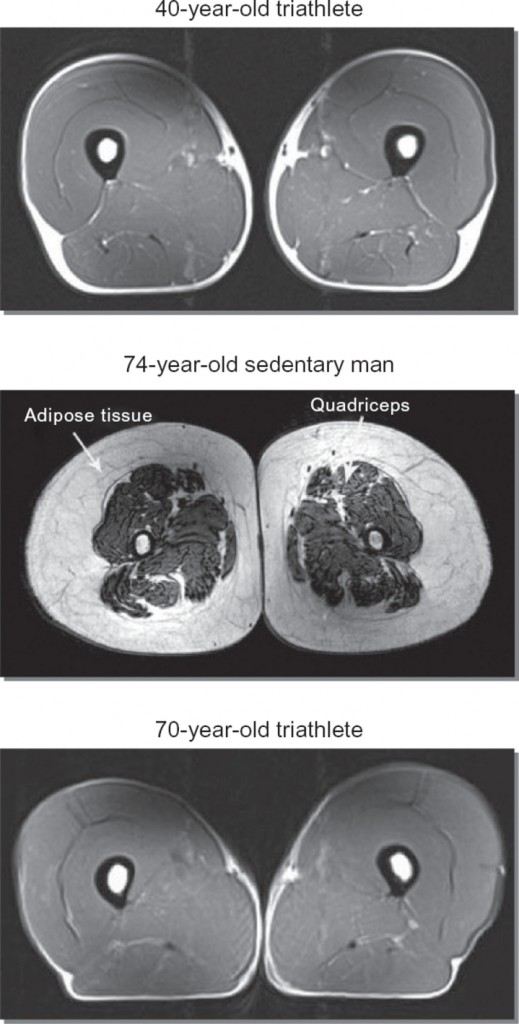
Muscles, Athletes, MRI

Which one do you want to be when you grow old?

While most of the medical establishment (and people providing dietary advice) have been saying for some time that losing weight is good for your health in the long term, it seems in fact that having more muscle mass, even with a higher BMI, is a better predictor of outcomes.

Simply put: Don’t just try to lose weight; put on some muscles. It’s better for you.

I’m no expert, but I can think of many reasons why that would be logical, beyond the fact that diet alone never works:

  1. Muscle mass is what burns the most calories; so the more muscle mass you have, the higher your base metabolism, and therefore the less you tend to gain weight. Or the faster you burn through extra reserves. Remember that excess weight, especially abdominal fat deposits, is a major risk factor; but muscles burn calories, so you don’t need to starve yourself half to death to lose the weight.
  2. Muscles are what put strain on your bones, and therefore keep them from becoming weak (in reaction to the strain, bones become denser, and more sturdy). Stronger bones means less chances of fractures, which is an important contributor to loss of autonomy and health in older age.
  3. A stronger body in general is insurance against injuries caused by attempting to perform tasks that once were normal, but that become a challenge as we age. We’re not old in our heads, so when we think we can do something, but have not maintained our bodies, we run the risk of getting hurt.

The main issue, as I see it, is that as we age (starting around our mid-twenties), our metabolism and hormonal equilibrium shift, and it takes some activity to maintain muscle mass. It is not automatic that we gain weight, but if we lose muscle mass because we don’t use it enough, then we start to burn less, and thus put on the weight.

A good remedy to that is to maintain muscle mass. Or re-build it.

This is where No-brainer Fitness: E comes in, as a third part to the initial comparison.

The first thing to focus on when beginning a new regimen of activity is re-building muscle mass. And that is precisely what occupies a great deal of the time of No-brainer Fitness: E.

The best way to protect your body against excess weight and injuries is to have a stronger body.

And now, it seems, research is showing that long-term health is better if you have greater muscle mass.

So put first things first, and re-build (or maintain) that muscle mass. (Which is not the same as saying that you should not do any cardio, or eat badly. It’s just a place to start…)

References:

Muscle mass index as a predictor of longevity in Older adults, The American Journal of Medicine (article in press), 2014

The article from which the MRI images are claimed to originate can be found here.

Watch Paddy and Nico here. (Hopefully that link is still up…)

The best moment of the day to exercise

Movement, Daily, Morning

Seize the day!

We all should be moving all the time, be true Everyday Athletes. But let’s face it, most of us have jobs that tie us down to a desk for large chunks of the day.

So the question can be raised: When, on any given day, should we exercise in order to fit it all in?

The answer, of course, is: first thing in the morning.

There you go, question answered. Shortest blog post ever!

Ok, maybe not.

Leaving aside the facile answer (which, for many reasons, remains probably the right answer for many), let’s have a look at the pros and cons of various moments of the day.

Assume for the sake of this discussion, that you are doing “some” exercise only. It could be the basic program of No-brainer Fitness: E, or some other light to moderate training regimen…

The Morning: Seize the Day!

The main positive aspects of exercising first thing in the morning is that you can make sure that it gets done. Especially if it is a short routine that only takes a few minutes, there’s no time like the present to get it done!

You are also mentally most energetic at this time of day; your stores of willpower and decision-making energy are full from a good night’s rest, so there is less chance you will give up in the middle of your routine.

However, be careful of eating a little something (unless you are purposefully training “on empty”) because you might not feel enough physical energy.

The main drawbacks to exercising in the morning come from family life and logistics in general. If you have kids, it is often hard to get everything prepared and the kids ready and fit some exercise in the morning. Also, having to get everything or everyone else ready then head over to a gym or pool, and then get ready yourself for work, is a major hassle.

It may be difficult to get the kind of class or training session you seek at a time and location that is practical for you in the morning. So perhaps mornings are not best for you.

However, for short exercise routines that don’t need to be done at a gym or pool, and especially with a good partner to share the load, the morning time remains ideal for exercise.

Also, a lot of the morning pressure can be lifted by getting up earlier, for instance well before the kids, and doing your exercise then. This can become your personal time. But make sure to get to bed earlier as well (getting to bed too late is a major problem in modern life, about which it is high time I write something on this blog…).

Lunch Time or Mid-Day: Re-energize!

The main positive aspect of exercising in the middle of the day is that it provides a very good break from work, and can even replenish your energy levels for the rest of the day.

It is certainly always a good change of pace, if you can swing it.

Unfortunately, most people’s lunch time is often too short to be of much use, especially considering the need to go somewhere, get changed, exercise, get changed again, go back, and still find time to eat something.

If you can just zip out for a run or a brisk walk, that’s great. And there might be some short fitness classes offered near your work. Much of anything else is sure to be a logistical challenge.

Our modern schedules are bad. We really should be able to take the time we need during the day to stay fit. Our productivity would soar! But until that’s the case, exercising in the middle of the day won’t be ideal.

Evening: Make or Break Time!

Everybody’s favourite time of day; freed from work, time for ourselves… and family/household obligations.

The evening provides far more flexibility for exercising, and there are plenty of activities to choose from. It would seem ideal at first, but there are major drawbacks.

By this point, even if you’ve psyched yourself all day, you are at your most tired mentally. And at the greatest risk of simply skipping the workout.

Also, there are equally many things to juggle at night: cooking, homework, dishes, catching up on your partner’s day, etc. Making time for exercise is even more an issue in the evening as it may seem to be in the morning. And without clear deadlines (school or daycare time, being at work, etc.) the temptation to take it easy so as to stress less often leads to overruns and something having to drop. Care to guess what is most likely to get dropped?

If you are still keen and decide to exercise “later”, say as last thing in the evening, then you face the worst possible scenario: needing another meal, and not being able to fall asleep for quite some time. Indeed, the boost to your hormonal levels and wakefulness due to exercise, and the need to refuel, will push your bedtime to the point of making getting up the next day a Herculean task.

Some light routine, a bit of strength work and relaxing stretches, or making sure your training is before dinner time, can work just fine.

So there you have it, more fully.

When’s the best moment to exercise? Whenever it works best for you.

But if you are thinking about starting a new routine, consider making it a morning one, and making sure you get that sense of accomplishment first thing in the morning, to give a positive outlook on your entire day…

(And this turned out to be one of my longest posts. But it could have been the shortest.)

Photo by Pixabay.

From the Library of No-brainer Fitness

Books, Exercise, Diet, Willpower, Happiness, Paleo

So many books, so little time…

A really short post, for a change. You probably did not think it possible coming from me, yet here it is.

Here are books I’ve recently read, or am currently reading, and that I highly recommend. Perfect for a rainy Sunday afternoon…

The Paleo Diet for Athletes: The ancient nutritional formula for peak athletic performance. By Loren Cordain, Ph.D., and Joe Friel, M.S. Not exactly a day-to-day guide to nutrition since I don’t subscribe to everything that is “paleo”, but certainly an inspiration for reducing carbs and eliminating processed foods and NOT FOOD (a work in progress). I particularly like the pragmatic approach to eating paleo when doing endurance sports, which is of course not a strict paleo diet.

The Willpower Instinct: How self-control works, why it matters, and what you can do to get more of it. By Kelly McGonigal, Ph.D. This book is structured like the lecture series she gives at Stanford University, and contains exercises to be done week after week, so it takes a while to get through it in order to really benefit from the material. But it is worth the effort. One of the key elements for having more willpower is to be fit (exercise, sleep well, etc.), and of course some willpower is useful to keep us moving everyday. So it is a positive feedback loop.

Spark: The revolutionary new science of exercise and the brain. By John J. Ratey, MD. I just started this, after first encountering him in a FranklinCovey lecture and then listening to his TED talk, so too early to give a review, but very promising.

Eating on the Wild Side: The missing link to optimum health. By Jo Robinson. This is from an investigative journalist in the field of food (agriculture, nutrition, “field”, get it?). What’s really interesting is the discussion about changes some 10,000 years of human selection and hybridization of plants have made to what we put in our digestive systems. Basically, a truly paleo diet is impossible nowadays, because the food that existed then no longer exists. Case closed. A quick read, and quite enlightening, and many interesting tips that can be consumed over time.

The Happiness Advantage: The seven principles of positive psychology that fuel success and performance at work. By Shawn Achor. A bit of a personal thing, but highlighting how important it is to have a balanced life, to exercise, eat, and sleep well. Let’s face it: it is all inter-related.

All of the above are easy to find in either paper or electronic versions.

Next on my list is to read Dr. David L. Katz’s book on nutrition and health; once I’ve done that, I’ll likely spend much more time talking about it.

Good reading!

Photo from Pixabay.

Slow, smooth, steady… healthy!

Slow is smooth...

Slow is smooth…

There is a saying in swimming: Slow is smooth, smooth is fast.

Simply put, you are better off having a slow, technically sound rhythm, which makes for smooth motion in water, rather than rushing through your movements (and splashing about a lot more, which is NOT smooth), because ultimately smooth movement through water will make you go fast.

This saying applies to life in general. Better to act in a “slow” (read: planned, thoughtful, methodical, mindful) way, which will cause you to do whatever you do smoothly, and ultimately to complete projects and tasks faster than if you rush through and must correct mistakes and re-do the work over and over again.

And, of course, it applies to fitness and health as well. (Otherwise, I would not be writing this post.) Though, to bring the point home, I might re-phrase it thus:

Fitness is daily, daily is healthy.

Basically, putting yourself through grueling workouts 3 or 4 times (or more?!) per week, thereby risking injury and burning-out, can be counter-productive. Especially if the rest of the time you minimize your activities, sitting on your chair at work, on your couch at home, and in your car in-between.

Don’t get me wrong: working out hard can be a lot of fun. And it can serve the purpose of preparing your body for big events like running a 10k, doing a triathlon, etc., which are extra-ordinary demands to put on your body. And working out hard can be a great feel-good moment in your week. But if it is unsustainable, it becomes like yo-yo dieting, and that’s not healthy for your body.

The key to fitness that leads to long-term health, ultimately, is to have good, steady habits on a daily basis. It is everyday fitness that will protect you from having to re-start a training program over and over again because each time you do it becomes overwhelming, or you end up hurting yourself.

So be slow, be smooth, be steady in your activities. Be an everyday athlete. And increase your odds of being healthy for a good, long time.

...smooth is fast.

…smooth is fast.


Photos from Pixabay.